

The 100-Day Business Growth Framework: Phases, Targets, Deliverables
A detailed breakdown of the 100-day growth framework: three 30-day phases, revenue targets, deliverables, and the financial guarantee behind it.
TL;DR
The 100-Day Growth Framework is a three-phase structure that takes a small service business from setup to stable revenue in 100 days. Phase 1 is foundation (days 1–30). Phase 2 is financial modeling and sales refinement (days 31–60). Phase 3 is operations and scale (days 61–100). The targets are concrete, the deliverables are fixed, and the guarantee is contractual.
What is the 100-day growth framework?
The 100-day framework is a three-phase, time-boxed engagement that compresses business foundation, sales refinement, and operations setup into 100 days with specific revenue targets and deliverables at each phase.
The structure exists because service businesses stall at predictable points. Month one: they build a website. Month three: they still have no clients. Month six: they blame the website. The real problem is that foundation work, lead generation, sales process, and unit economics all need to happen in parallel, and most founders try to do them sequentially. By the time the last piece lands, they’ve run out of runway.
A Small Business Administration study on growth stages shows that 82% of service-business failures trace to cash flow issues, not demand issues, meaning founders have customers but can’t model the economics fast enough to price correctly. The 100-day structure addresses this by forcing financial modeling into Phase 2, before the founder gets locked into unprofitable pricing.
Phase 1: What happens in the first 30 days?
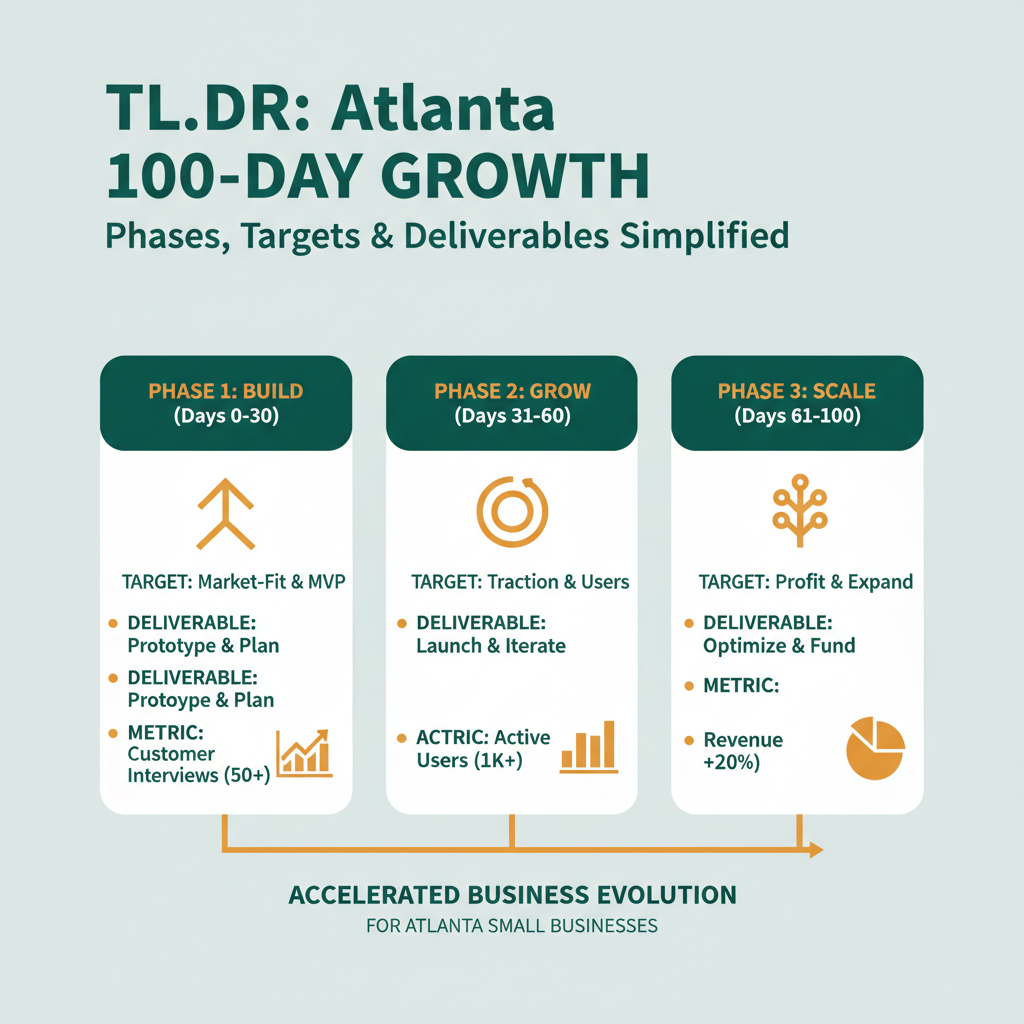
Phase 1 is Clarity and Foundation. Business setup, digital infrastructure live, first paying clients, and one lead channel committed, with a revenue target of $100 to $1,000 per month.
The deliverables in days 1–30 are concrete. Business entity and banking reviewed and corrected if needed. Custom Astro website built and deployed to Cloudflare Pages [pctx_011]. Local SEO foundation in place (Google Business Profile claimed, on-page schema deployed, initial citations submitted). GoHighLevel CRM configured with pipelines and lead capture. One primary lead channel committed to, usually local search, cold outreach, or referrals, and tested with real traffic.
The revenue target of $100–$1,000 per month sounds low. It’s intentional. The point of Phase 1 is not volume, it’s proof that the machine turns. A single paying customer validates the pricing model, the sales process, the onboarding flow, and the delivery workflow. Without that validation, scaling in Phase 2 scales a broken process. According to First Round Review’s work on early traction, the single biggest predictor of a scaling business is whether the first 5 customers arrived through a repeatable channel.
Phase 1 also ends with the partner’s first Growth Analytics Checkpoint, a review meeting where we look at what worked, what didn’t, and which lever to pull in Phase 2.
Phase 2: What happens days 31 to 60?
Phase 2 is Consistency and Conversion. The outreach scales, the sales process gets refined, the financial model gets built, and the first CAC/LTV review happens. Revenue target: $1,000 to $4,000 per month.
The financial modeling is the piece most small businesses never get. In Phase 2, the finance side of Cause & Effect builds a full unit-economics model: customer acquisition cost (CAC), customer lifetime value (LTV), contribution margin per customer, break-even point, and a 12-month revenue projection. This isn’t a spreadsheet we hand over, it’s a living model we update weekly based on real numbers from the CRM.
McKinsey’s research on small business scaling found that businesses with formalized unit-economics tracking grow 47% faster than those relying on gut feel. That’s not surprising. You can’t optimize what you don’t measure. Most founders know their top-line revenue. Almost none know their contribution margin by service or their blended CAC across channels. Phase 2 fixes that.
The sales process refinement is the other half. By day 45, most partners have 5–15 sales conversations logged. That’s enough data to identify where the funnel leaks, objections, pricing pushback, slow response time, unclear value proposition, and tighten it. Small changes at this stage compound fast. Moving a close rate from 12% to 18% on the same lead volume is a 50% revenue increase with zero new marketing spend.
Phase 3: What happens days 61 to 100?
Phase 3 is Scale and Stabilize. Operations SOPs get built, scenario modeling runs, a comprehensive growth report is produced, and a six-month forward plan gets written. Revenue target: $5,000 to $10,000+ per month.
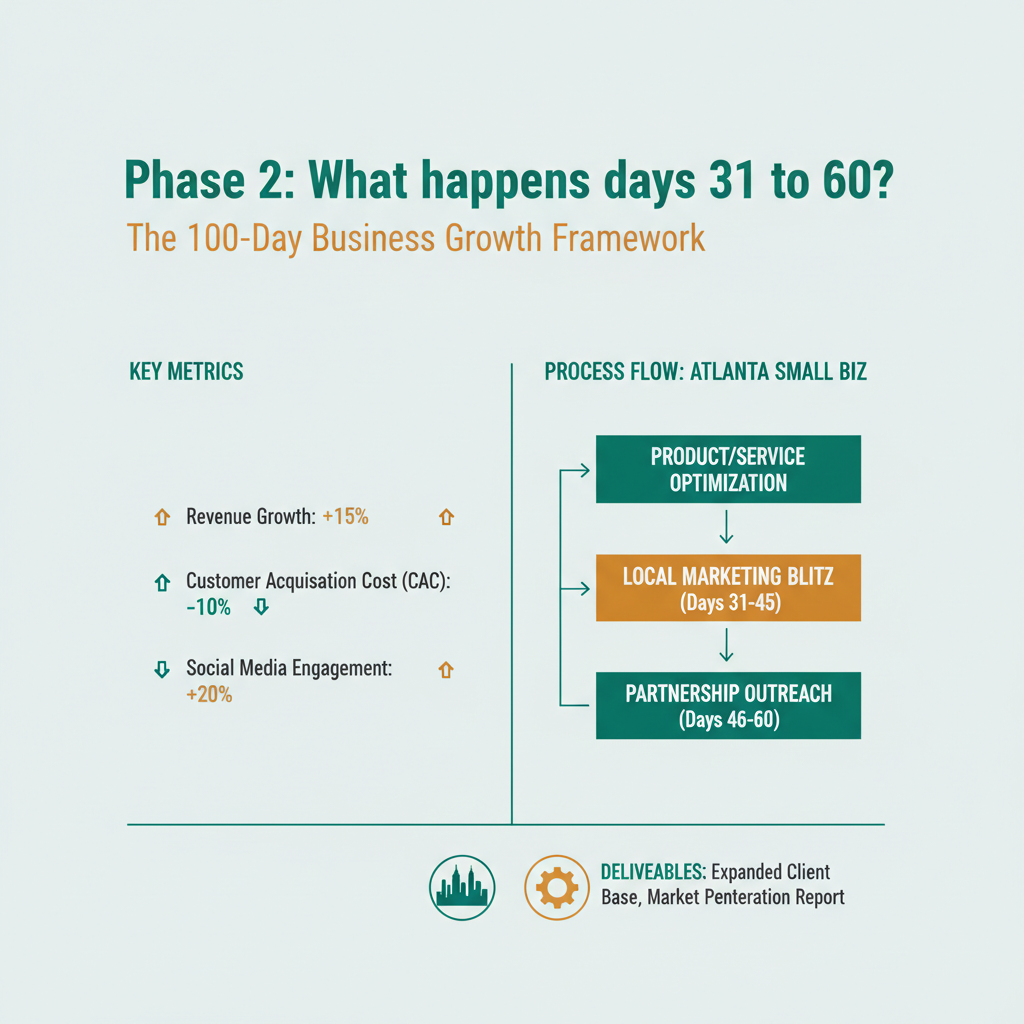
By day 61, the partner has a validated sales motion, a working financial model, and enough customer data to see patterns. Phase 3 turns those patterns into systems. Standard operating procedures for client onboarding, service delivery, invoicing, and follow-up. Scenario modeling that shows what happens to revenue and margin under different growth rates, pricing changes, or team additions. A capacity plan that maps when the founder needs to hire, outsource, or restructure.
The scenario modeling piece is where the ISYE discipline shows up hardest. We run sensitivity analysis on the partner’s revenue and cost drivers, if average deal size increases 20%, what happens to contribution margin? If lead volume doubles but close rate drops 15%, does the business still scale profitably? These aren’t academic exercises. They’re the questions a founder needs answered before hiring their first employee or committing to a lease.
Profit First by Mike Michalowicz argues that most small businesses never institutionalize profitability until they hit $1M in revenue, and by then, the habits are locked in wrong. Phase 3 institutionalizes it before the partner scales past the point of easy correction.
What are the revenue targets, and are they realistic?
The revenue targets are realistic because they’re anchored to customer math, not aspiration. Phase 1: $100–$1K. Phase 2: $1K–$4K. Phase 3: $5K–$10K+.
| Phase | Days | Name | Target | Key Deliverables |
|---|---|---|---|---|
| 1 | 1–30 | Clarity & Foundation | $100–$1K/mo | Site, CRM, first clients, one channel |
| 2 | 31–60 | Consistency & Conversion | $1K–$4K/mo | Financial model, sales process, CAC/LTV review |
| 3 | 61–100 | Scale & Stabilize | $5K–$10K+/mo | SOPs, scenario modeling, 6-month plan |
Let’s ground the math. A partner charging $500 per service needs 2 customers in Phase 1, 8 in Phase 2, and 20 in Phase 3 to hit the high end. A partner charging $2,000 per service needs 1, 2, and 5 respectively. Neither number is heroic, but they require a working funnel, which is what the phases are built to produce [pctx_011].
One partner followed this exact structure and reached $30,000 per month with 100+ clients in nine months [pctx_014]. That’s 3x the Phase 3 ceiling, achieved three months past the end of the framework. The 100 days aren’t the end, they’re the point at which the machine is built. What happens after is leverage on a working system.
What is the 100-day delivery guarantee?
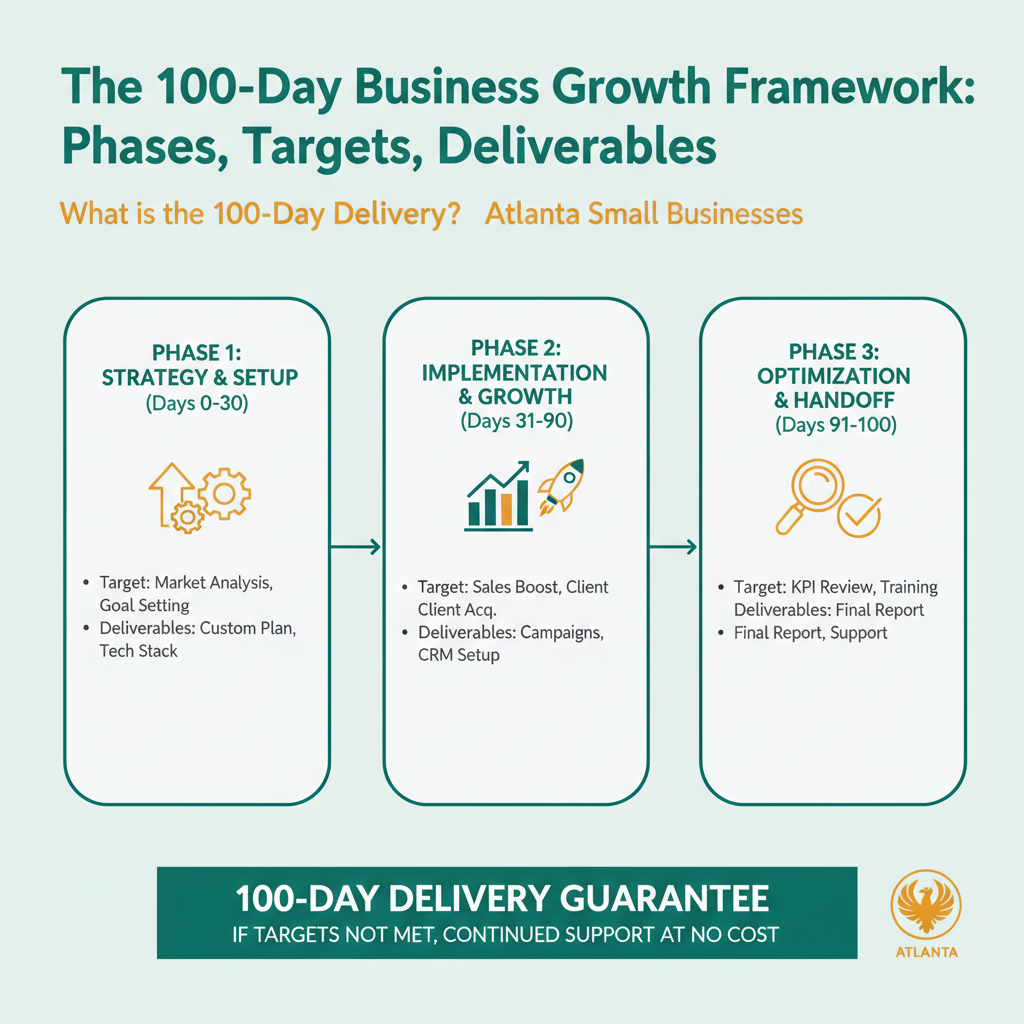
The guarantee is contractual: a fully operational digital presence, lead generation system, and financial framework delivered within 100 days, or Cause & Effect keeps working at no additional cost until delivered.
The guarantee matters because the profit-share model already puts skin in the game [pctx_015]. If we don’t deliver the infrastructure, the partner has no path to revenue, and we have no path to profit-share. The guarantee formalizes that mutual dependency. If day 100 arrives and the site isn’t live, the CRM isn’t configured, or the financial model isn’t built, we keep working without charging anything additional until it is.
This isn’t a gimmick. It’s the logical consequence of profit-share pricing. A retainer agency can under-deliver and still collect the invoice. We can’t. The model only works if the partner hits revenue, and the partner only hits revenue if we deliver the infrastructure. The guarantee just writes down what the economics already enforce.
How does this fit Atlanta service businesses?
The framework is built around Atlanta service businesses because that’s where we work, and the density of small, owner-operated service businesses in the metro makes the three-phase math land cleanly.
We’ve run partners in Atlanta, Decatur, Sandy Springs, Marietta, and Roswell. The pattern holds across verticals: legal, home services, creative, consulting, health and wellness. What matters is not the industry, it’s the five qualification criteria: existing business model, 20+ hours/week commitment, coachability, work ethic, and growth intent.
Partners who don’t qualify for the framework still get access to the commercialized services: SEO strategy, web design, CRM setup, paid ads, and content marketing. Same quality, different structure, flat fee.
What does Phase 4 look like?
Phase 4 doesn’t exist in the framework, by design. The 100 days build the machine. Month 4 and beyond is the partner running it.
We stay engaged after day 100. The profit-share continues, the dashboards continue, the monthly analytics checkpoints continue. But the framing changes. The first 100 days are the build. After that, it’s operations and optimization, which is a different kind of work with different cadences and different deliverables. Trying to extend the framework past 100 days would dilute what makes it sharp.
The zoomed-out version: 100 days is a commitment to finish building before you start running. Most founders start running before the build is done, which is why so many businesses stall at $3K–$8K per month with no clear path up. The framework is a structured way to not make that mistake.
FAQ
What if I don’t hit the Phase 1 revenue target?
Phase 1 is about infrastructure and process, not volume. If revenue is below $100/mo at day 30 but the site is live, CRM is configured, and one lead channel is tested, we proceed into Phase 2. If nothing is working at day 30, no leads, no channel, no conversations, we stop and rediagnose before scaling a broken system.
How many hours per week does the partner need to put in?
20+ hours per week minimum. This is non-negotiable. The framework assumes founder-led execution on sales, customer delivery, and operational decisions. We handle the digital, financial, and strategic work, but we can’t replace the founder in customer-facing activity.
What happens on day 101?
The partnership continues month-to-month. Profit-share continues at 12%. The dashboards and checkpoints stay active. Day 101 isn’t an ending, it’s the transition from build mode to operate mode.
Can the framework run longer than 100 days if things are going slow?
Yes. The guarantee specifically covers this, if deliverables aren’t complete at day 100, we keep working at no additional cost until they are [pctx_015]. The 100 days is a target, not a hard cutoff.
Does the framework work for e-commerce or product businesses?
The framework is designed for service businesses. Product and e-commerce businesses have different unit economics (inventory, shipping, returns) that require a different structure. We’ve adapted the framework for product businesses before, but it’s not the default.
Is there a minimum revenue requirement to start?
No. Partners can start at $0 in monthly revenue. Qualification is based on commitment, coachability, and growth intent, not current revenue. A validated idea with no customers is enough.
What does “validated idea” mean for qualification?
An idea is validated when it has either paying customers (even one), documented demand (inbound inquiries, waitlist), or market proof (competitors making money in the same space). Ideas without any of those three signals are too early for the framework.
How is progress measured during the 100 days?
Weekly check-ins with progress against phase deliverables. Monthly Growth Analytics Checkpoints with the finance side of the team. Live dashboard showing revenue, CAC, LTV, leads, and conversion rates. No monthly PDF reports, everything is live.
Get in Touch
If the three-phase structure matches where you are and where you want to be, book a qualification call. We’ll walk through the phases, review your current state, and tell you honestly whether the framework is the right fit. No deck, no pitch, just the math and a clear next step.
Christopher Drake Griffith is the co-founder of Cause & Effect Strategic Partners. Based in Atlanta. Georgia Tech ISYE. LinkedIn.
Last updated: 2026-04-15