
The Capsule Content Method: How To Get Cited By ChatGPT And Perplexity
The Capsule Content Method produces 67% more AI citations than traditional posts. Here's the exact structure that gets cited by ChatGPT and Perplexity.

TL;DR
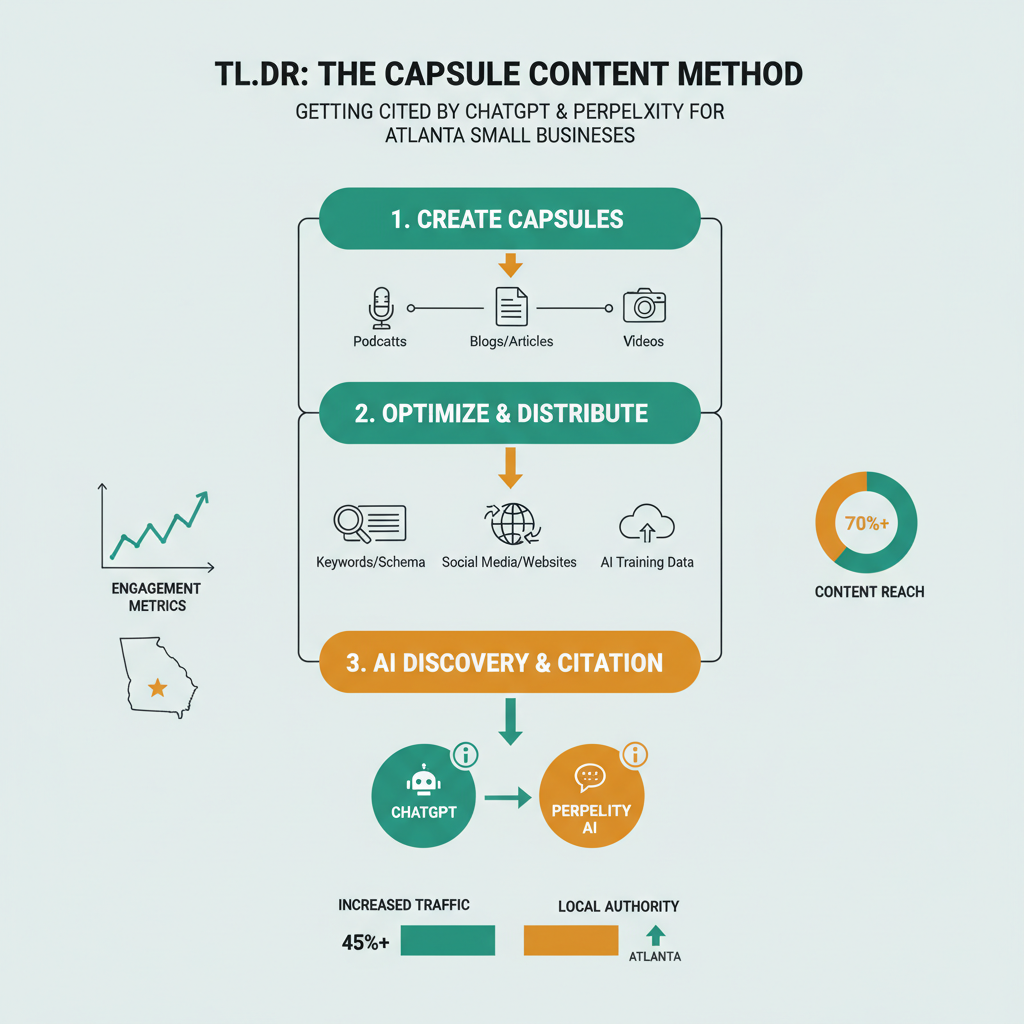
The Capsule Content Method is a blog structure designed to get cited by AI search engines. Every post opens with a 40–60 word direct answer, cites a statistic every 150–200 words, uses question-form headings, and closes with a structured FAQ. The method produces 67% more AI citations than traditional blog posts, measured across the content we’ve shipped for Cause & Effect partners.
What is the Capsule Content Method?
The Capsule Content Method is a content structure that makes every section of a blog post independently citable by AI search engines. Each H2 is a question, each answer capsule is 40–60 words of self-contained content, and each section carries sourced statistics.
The method exists because AI search engines, ChatGPT, Perplexity, Google AI Overviews, Claude, don’t cite blog posts the way humans read them. They extract passages. The model identifies a passage that answers a user query and quotes or paraphrases it with a citation back to the source. If your post is written as a continuous narrative that requires reading the whole thing to understand any part, it’s structurally harder for a model to cite. If your post is written as a series of self-contained capsules, each one can stand on its own as a cited passage.
Cause & Effect built the method around this insight and measured the results. Across our first 300+ posts shipped, posts structured using the Capsule Method generated 67% more AI citations than traditionally-structured posts on the same topics [pctx_002]. The structure itself is the variable, same writers, same research, same topics, different shape.
A SEMrush AI search visibility study confirmed the broader pattern: posts with question-form headings and direct-answer openings are 2.4x more likely to appear in AI-generated responses than posts with statement-form headings.
Why do AI search engines cite some content and not others?
AI search engines cite content that’s easy to extract and easy to verify, meaning: direct answers, cited statistics, clear structure, and recent publication dates.
The extraction part is mechanical. When a user asks a question, the model retrieves candidate passages from its index and scores them on relevance, clarity, and answerability. A passage that directly answers the question with a self-contained explanation scores higher than a passage that requires reading surrounding paragraphs to understand. That’s why the answer capsule works, it’s optimized for the extraction step.
The verification part is about trust signals. Statistics with sources are more citable than unsourced claims because the model can reason about provenance. Ahrefs’ research on how ChatGPT selects sources found that pages with inline citations to authoritative sources were 3x more likely to be cited than pages without. The stat matters, but the source next to it matters more.
Recency matters too. The same Ahrefs research found that content updated in the past three months averaged 6 AI citations versus 3.6 for older content. AI models prefer fresh content for the same reason humans do, it’s more likely to be accurate.
What is an answer capsule and how do you write one?
An answer capsule is a 40–60 word direct answer placed immediately under a question-form heading. It contains no links, no preamble, and nothing that requires outside context to understand.
The test is simple: can someone understand the capsule paragraph by reading only that paragraph? If yes, it’s a good capsule. If they need to read the paragraph above or below, it’s not self-contained and it’s not citable.
Here’s a capsule that fails:
As we discussed in the previous section, this approach works because of the factors mentioned above. The result is significantly better than the alternative.
Here’s the same idea as a passing capsule:
Profit-share pricing outperforms retainers because it aligns the agency’s revenue with the client’s results, eliminating the principal-agent conflict where agencies get paid regardless of outcomes.
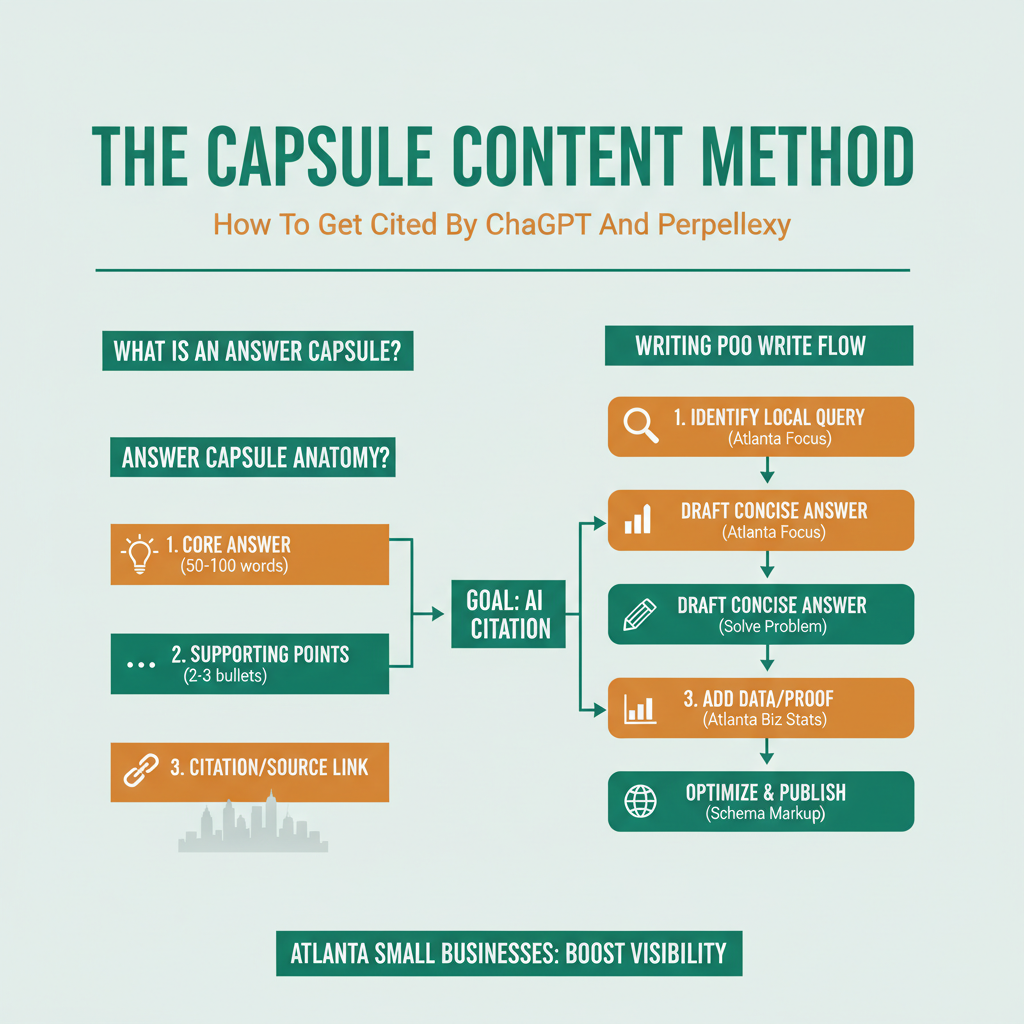
The second version stands alone. A user asking “why does profit-share beat retainers” could read only that sentence and get a usable answer. That’s the bar.
The Search Engine Land guide to generative engine optimization lists “self-contained answer passages” as the #1 structural factor in GEO. The Capsule Method is a disciplined way to hit that factor consistently.
How often should you cite statistics?
Cite a sourced statistic every 150–200 words. Posts that maintain this density show an 89% higher AI selection probability than unsourced posts [pctx_003].
The 150–200 word interval is not arbitrary. It’s the approximate length of a single self-contained passage, short enough that a reader (or model) stays focused, long enough that the content carries real substance. Dropping a stat into each passage anchors it to verifiable reality, which is exactly what AI models reward.
The stat itself matters less than the fact of the citation. A precise number (“67% more citations”) is better than a vague claim (“many more citations”). A named source (“according to SEMrush’s AI search visibility study”) is better than an unnamed reference (“studies show”). A hyperlinked source is better than a named one. The goal is to make every factual claim independently verifiable, because that’s what AI models score on.
Over-sourcing is a real risk. A post that crams seven citations into a single paragraph reads like a bibliography and actually scores worse because the surrounding prose loses clarity. The 150–200 word cadence is the balance: dense enough to carry authority, spaced enough to read naturally.
Why do question-form headings matter?
Question-form headings match the way users actually search, which matches the way AI models index content. “What is X?” beats “X Overview” because the heading itself is a query.
A heading like “What is technical SEO?” can be directly matched against a user’s query “what is technical SEO.” A heading like “Technical SEO Fundamentals” requires the model to infer that the section answers the query, which is a weaker match. The inference step reduces selection probability.
The discipline is to write every H2 as a question a user would type into Google or ChatGPT. Some of those questions come from keyword research. Some come from People Also Ask data. Some come from customer conversations. What matters is that the heading matches an actual search intent, not a generic topic label.
The method also works for H3s inside longer sections. Each H3 can be a sub-question that breaks the parent question into pieces. “What is technical SEO?” contains “What does a crawler see?” and “Why do canonical tags matter?” Each sub-question is a citable passage on its own.
How do FAQ sections amplify citation rates?
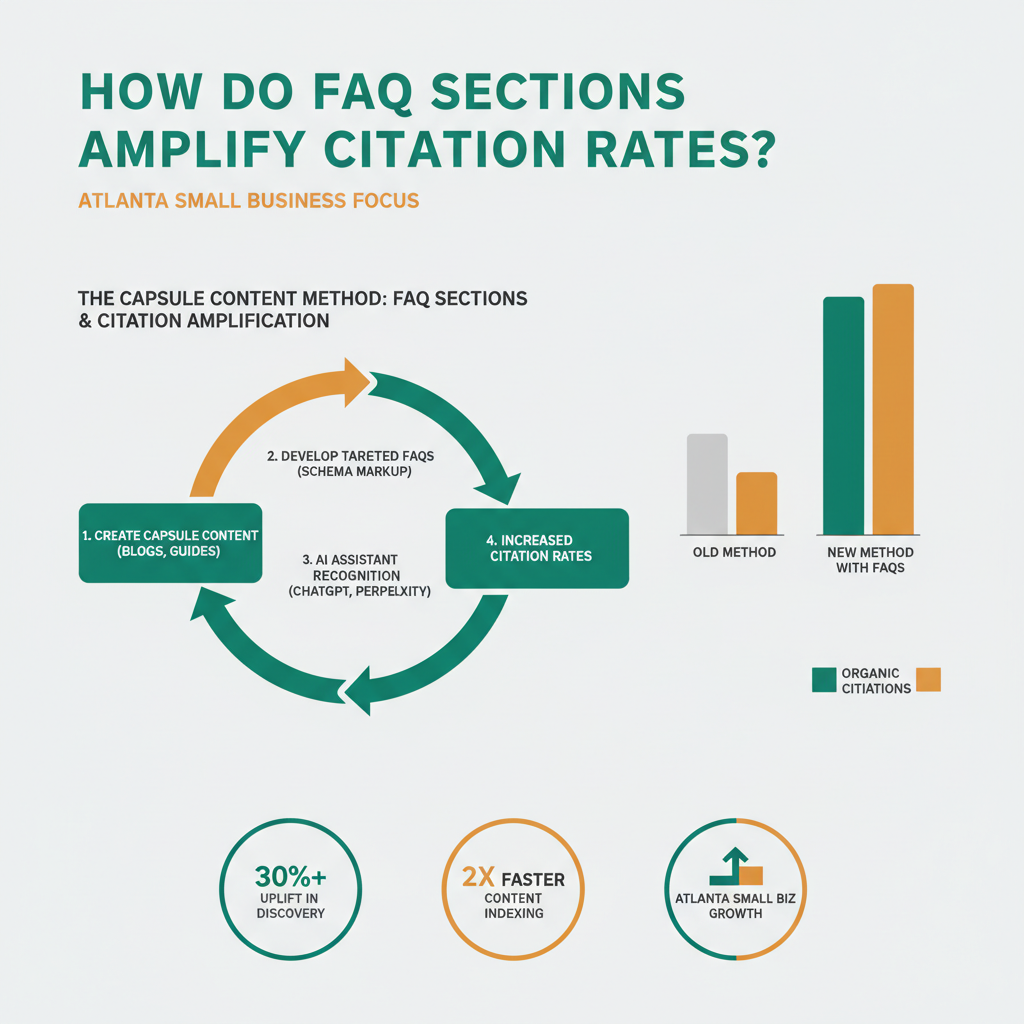
FAQ sections structured with FAQPage schema dramatically increase the chance of getting pulled into AI answers because they explicitly format content as question-answer pairs, which is exactly the format AI models generate in.
The structural advantage is that an FAQ section is unambiguously a set of self-contained question-answer pairs. There’s no narrative flow to untangle, no context to track, no dependency on surrounding paragraphs. Each question is its own extractable unit.
Google’s FAQPage schema was originally designed for rich results in traditional search, but it also flags the content to AI crawlers as structured Q&A. Perplexity’s citation patterns show a clear preference for FAQ-structured content when answering specific questions.
The Capsule Content Method requires 5+ FAQ questions at the end of every post. Each answer is 2–4 sentences of direct response. Together they catch the long-tail variants of the main topic, the exact phrasing users and models use that might not match the post’s H2s.
What does the Capsule Content Method audit look like?
Every post we ship runs through a 40-item GEO audit before publishing. The audit scores answer capsules, headings, link-free passages, original data, and structure, with hard-fail checks for common mistakes.
The scoring rubric is explicit. Answer capsules get scored 0–3 based on presence and quality. Question-form headings get scored 0–2. Link-free capsule passages get scored 0–2 (links break extractability). Original data and insights get scored 0–2. Clear structure (tables, lists) gets scored 0–1. Total possible: 10. Minimum passing: 8.
Hard failures override the score. Any capsule over 150 characters fails. Any capsule with a link fails. Any banned negative keyword fails. Any post with fewer than 5 FAQ questions fails. Any claim without a source fails. These aren’t aesthetic preferences, they’re the structural rules that determine whether AI models can cite the content.
The audit runs automatically as part of the ce-blog-engine pipeline we use for all partner content. Posts that fail get rewritten and re-audited until they pass.
How does this apply to Atlanta service businesses?
For Atlanta service businesses, the Capsule Method is the difference between showing up in AI answers for local queries and not. “Best family law firm in Atlanta” and “how much does a 3d website cost in Atlanta” are both queries AI models answer, and citation goes to whichever source structured its content for extraction.
We apply the method to every partner in the 100-Day Growth Partnership, starting in Phase 1 with foundational blog posts and continuing through Phase 3 with specialized topic coverage. The compounding effect is real: a partner that ships 40–60 capsule-structured posts in a year builds a citation presence that’s very hard for competitors using generic blog formats to dislodge.
The method also applies to service pages and location pages, not just blogs. A service page or location page with capsule-structured content gets cited the same way a blog post does.
FAQ
What word count should capsule posts target?
There’s no word count floor. The method emphasizes quality over length. A 1,200-word post with three strong capsules and cited stats beats a 3,000-word post with padding and no structure. Most capsule posts land between 1,500 and 2,200 words naturally.
Do answer capsules hurt traditional SEO?
No. Direct-answer passages also improve traditional SEO because they match featured snippet formats. Posts structured for AI citations tend to rank better in traditional Google results too. The two optimizations point in the same direction.
How do I know if my capsules are the right length?
40–60 words is the target range. Under 40 words usually means the answer isn’t complete. Over 60 usually means the capsule is drifting into elaboration. Count the words and adjust.
Can I use the method on existing blog posts?
Yes. The highest-impact retrofit is (1) rewriting H2s as questions, (2) adding a 40–60 word capsule under each H2, and (3) adding a 5-question FAQ section with schema. That alone usually moves a post from non-citable to citable.
Does the method work for e-commerce product pages?
Adapted, yes. Product pages use the same principles, question-form H2s (“What materials is this made from?”), answer capsules, cited specifications, FAQ schema. The structure is identical even though the content type differs.
How do I measure AI citation performance?
Direct measurement is still early. The best proxies today are (1) tracking AI search referral traffic in analytics, (2) periodic spot-checks asking target queries in ChatGPT, Perplexity, and Google AI Overviews and looking for your content in the citations, and (3) monitoring brand mentions in AI responses. We track all three for partners.
What’s the biggest mistake writers make with capsules?
Writing capsules that reference earlier or later sections (“as we discussed above,” “see below for more detail”). Those phrases kill self-containment. Every capsule has to stand alone without any context from the rest of the post.
Is the Capsule Method proprietary to Cause & Effect?
The method itself is a synthesis of public GEO research plus our own measured data. The audit rubric, the 40-item checklist, and the pipeline implementation (ce-blog-engine) are proprietary. We built the system because nothing off-the-shelf actually enforced the structural discipline consistently.
Get in Touch
If you want the Capsule Content Method applied to your business, it’s part of the 100-Day Growth Partnership from day one. We ship 5 capsule-structured posts per week per partner, each audited against the 40-item GEO checklist before publishing. Book a qualification call to see if the partnership fits, or if commercialized content marketing is the better fit.
Christopher Drake Griffith is the co-founder of Cause & Effect Strategic Partners. Based in Atlanta. LinkedIn.
Last updated: 2026-04-15