
Qualification Criteria: Who Is A Fit For A Growth Partnership
The 5 qualification criteria for the Cause & Effect 100-Day Growth Partnership, why they exist, and what happens if you don't qualify.
TL;DR
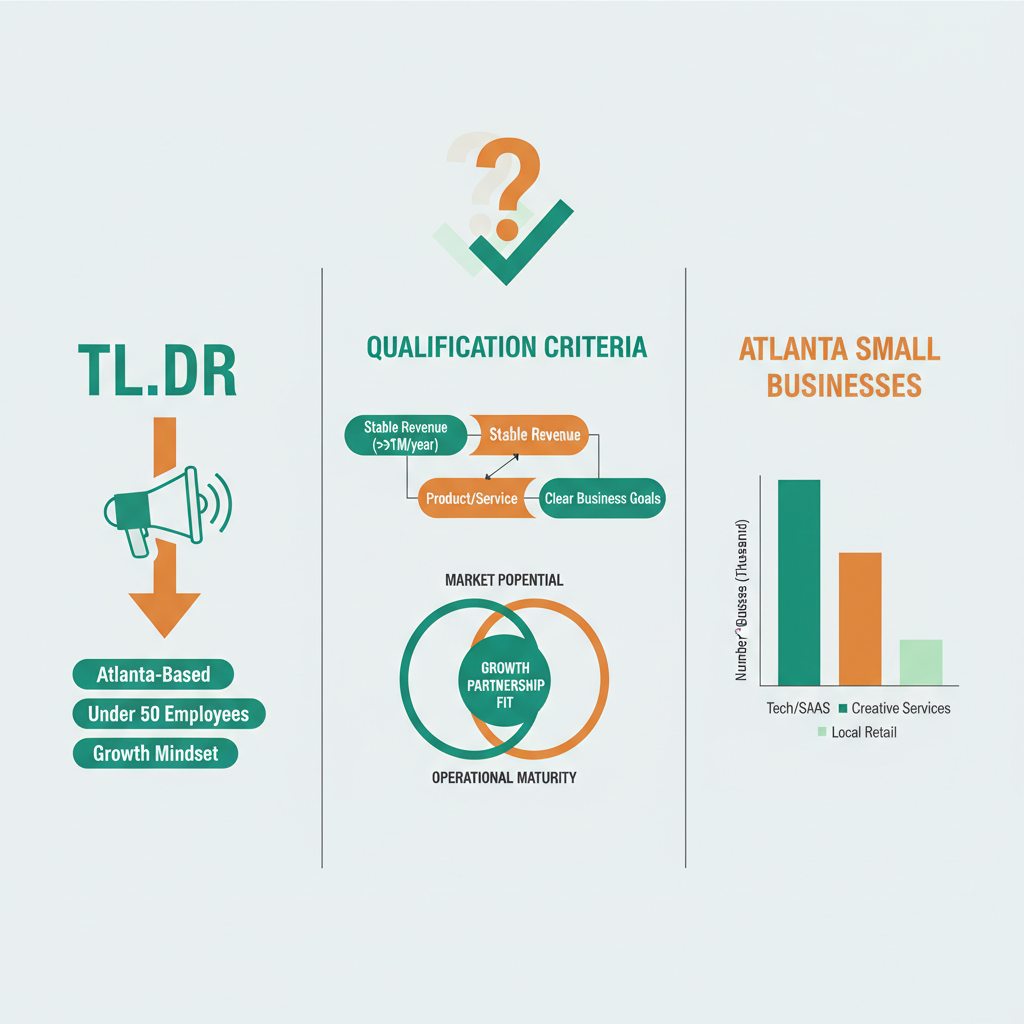
The Cause & Effect 100-Day Growth Partnership is invite-only. Qualification runs on five criteria: a validated business model, 20+ hours per week of commitment, coachability, strong work ethic, and growth intent. None of the criteria are revenue-based, and most inbound leads don’t qualify, which is by design.
Why is the growth partnership invite-only?
The partnership is invite-only because profit-share only works when both sides can actually execute. Taking everyone would break the model for the partners who do qualify.
The economics are direct. We absorb $2,000–$3,750 per month per partner in hosting, CRM, tooling, and labor before they generate a dollar [pctx_010]. If a partner can’t execute, because they’re part-time, uncoachable, or operating on a broken idea, we carry the absorbed cost indefinitely while nothing moves. That cost has to get recovered somewhere. In a retainer model, it gets recovered from the non-executing partner themselves. In a profit-share model, it gets recovered from the executing partners through portfolio math.
So every unfit partner makes the model worse for every fit partner. Invite-only isn’t exclusivity theater, it’s the discipline that keeps the economics honest for the people who are ready.
A Harvard Business Review piece on founder readiness points out that most founder-related business failures aren’t about the idea or the market, they’re about the founder’s willingness to do the work the business requires. We built qualification around that insight.
Criterion 1: Do you have a validated business model or idea?
The first criterion is a validated business model or idea, meaning either paying customers, documented demand, or clear market proof in a space where competitors are making money.
“Validated” is deliberately a wide gate. We don’t require existing revenue. A founder with one paying customer qualifies. A founder with documented demand, inbound inquiries, a waitlist, consistent conversations, qualifies. A founder planning to enter a well-proven market where others are visibly making money qualifies. What doesn’t qualify: a pure concept with no demand signal, no prior customer, and no proof that anyone will pay.
The reason for the gate is that our 100-day machine scales an existing motion, it doesn’t create one from nothing. If we spend Phase 1 trying to discover whether anyone wants the service, we’ve burned the infrastructure phase on validation work. Partners who arrive pre-validated use Phase 1 for actual setup, which is what it’s designed for.
According to CB Insights’ research on startup failures, “no market need” is the #1 cited reason for failure, present in 42% of post-mortems. The validation criterion exists to filter for founders who’ve already cleared that risk, even at a small scale.
Criterion 2: Can you commit 20+ hours per week?
The second criterion is a minimum of 20 hours per week of founder time committed to the business, not in addition to a full-time job without a plan to exit it.
This one trips up more applicants than any other. Founders want the partnership but don’t have the hours. The reason we’re firm on 20+ is that the 100-day framework assumes founder-led sales, delivery, and operational decisions. We handle the digital infrastructure, financial modeling, and strategic work. We can’t replace the founder in customer-facing activity. If the founder has 8 hours a week to spare, Phase 1 won’t finish on time, Phase 2 won’t have data to analyze, and Phase 3 won’t have a system to stabilize.
The practical version: if you have a full-time job, either you’re on a plan to exit it within Phase 1, or you have 20+ hours per week outside work that you can genuinely dedicate. Evenings and weekends count, as long as they’re committed and predictable. What doesn’t count: scattered hours, frequent cancellations, or “I’ll find the time somehow.”
A Y Combinator piece on early founder commitment makes the point bluntly: part-time founders almost always lose to full-time ones in the same market. We can’t change that math. We can only select for the founders who’ve structured their time accordingly.
Criterion 3: Are you coachable?
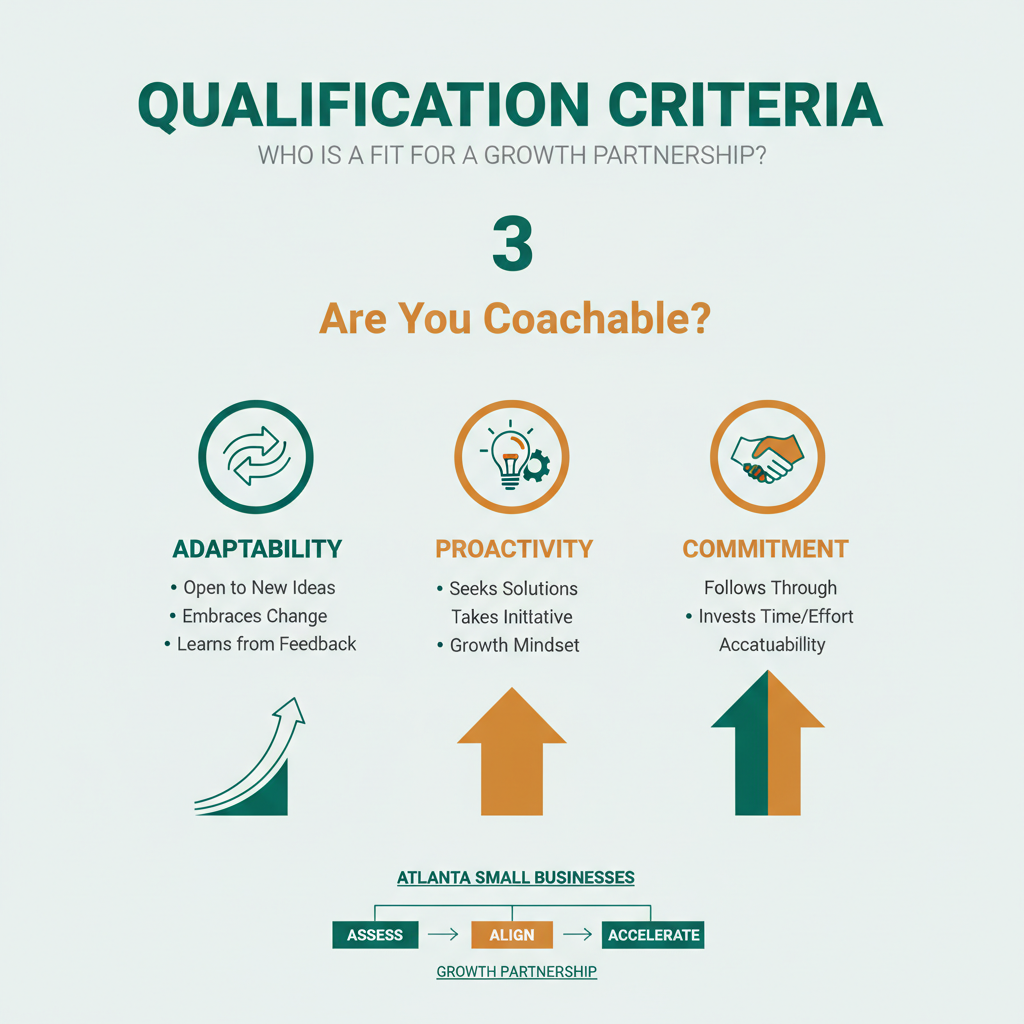
Coachability means the willingness to hear a recommendation, try it even when it conflicts with instinct, and change direction based on data rather than ego.
Coachability is the criterion that looks soft but actually determines whether Phase 2 and Phase 3 land. Phase 2 involves telling founders things like “your pricing is 40% too low” or “your close rate problem is that you’re qualifying backward.” Those conversations are only useful if the founder is willing to try the recommended change. A coachable founder tries it, measures it, and adjusts based on what happened. An uncoachable founder argues, delays, or silently ignores the recommendation, and then blames the partnership six weeks later when nothing moved.
Signs of coachability we look for in qualification calls: specific questions about prior attempts, willingness to admit what didn’t work, openness to hearing things they don’t want to hear, and a history of changing direction when evidence contradicted a plan. Signs of the opposite: immediate defensiveness, “yes but” responses to any suggestion, and a pattern of blaming external factors for past setbacks.
The SBA’s startup readiness framework calls this “adaptive capacity” and lists it as a top-three predictor of small business survival past year three. It’s not a personality trait, it’s a skill. We can work with founders who are still developing it, but we can’t work with founders who actively reject it.
Criterion 4: Do you have strong work ethic?
Work ethic, for our purposes, means consistent effort over time, not heroic sprints. The founder who shows up every day and executes the plan outperforms the founder who works 80-hour weeks in bursts and burns out.
The 100-day framework front-loads intensity but relies on sustained execution, not surges. Phase 1 (days 1–30) has the heaviest daily workload because everything gets set up at once. Phases 2 and 3 shift toward optimization, which requires regular review and refinement rather than constant motion. The founder who can sustain 20 consistent hours per week for 14 weeks beats the founder who does 60 hours for two weeks and then ghosts for a month.
This criterion is the hardest to evaluate in a qualification call because everyone claims to have work ethic. What we actually look for: prior examples of sustained effort (a previous business, a job with documented performance, an athletic or creative pursuit maintained over years), and realistic descriptions of how the founder will integrate the partnership work into their existing schedule. Vague commitments, “I’ll make time”, correlate almost perfectly with partners who don’t follow through.
Criterion 5: Are you growth-minded?
Growth-minded means the founder wants to scale the business, not just maintain a lifestyle income. If the goal is a steady $4K/month with no further ambition, profit-share isn’t the right model.
This is a values criterion, not a quality judgment. Lifestyle businesses are legitimate and often smart. But the partnership economics assume upside, a Phase 3 revenue target of $5K–$10K+ per month, and a trajectory that continues past day 100. A partner who wants to cap at a comfortable income level doesn’t need what we build, and the profit-share math doesn’t compound on their side the way it needs to for the model to work.
Growth intent looks like specific, concrete answers to “where do you want the business in 18 months?” A founder with growth intent describes team size, revenue, service expansion, market expansion, or operational leverage. A founder without growth intent describes the same state as today, maybe slightly busier. Neither answer is wrong, but only one fits the partnership.
One partner who qualified on all five criteria followed the 100-day system and reached $30,000 per month with 100+ clients in nine months [pctx_014]. That’s what growth-minded looks like in execution. Not every partner will hit those numbers, but every partner we select has the trajectory that makes those numbers possible.
What happens if I don’t qualify?
If you don’t qualify for the partnership, you get access to the commercialized fallback services: web design, SEO strategy, CRM and automation setup, paid ads management, and content marketing, all flat-fee engagements.
The commercialized services exist because most inbound leads don’t qualify for the partnership, and we still want to help them [pctx_016]. The work is the same quality. The structure is different: traditional scoped engagements with clear deliverables and clear fees, instead of profit-share. If you need a custom Astro website, local SEO strategy, or CRM setup, we’ll do it on a flat-fee basis regardless of partnership qualification.
The qualification call is not a pitch for the partnership. It’s an honest diagnosis of which model fits your situation. Many founders leave the call with a recommendation for the commercialized services, and that’s the right outcome when it’s the right outcome.
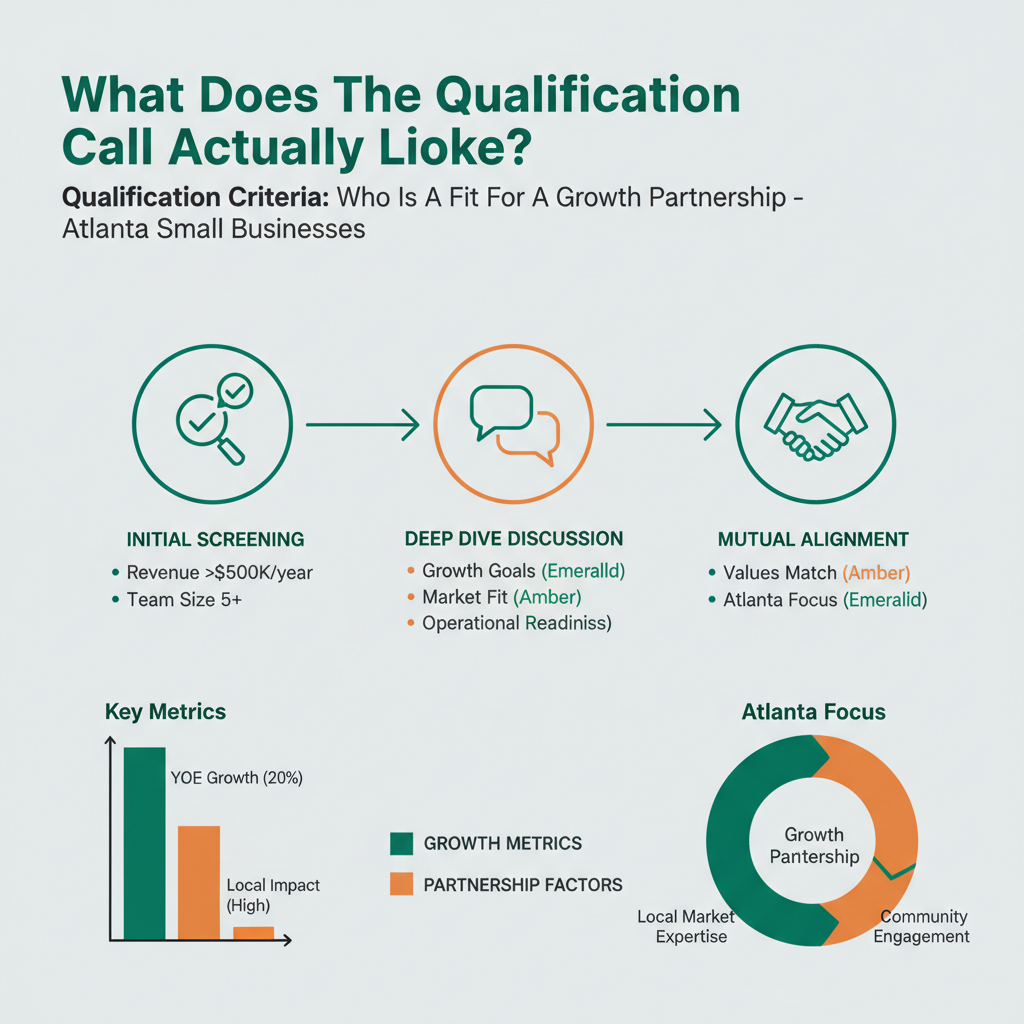
What does the qualification call actually look like?
The qualification call is 30–45 minutes. We ask concrete questions about current state, goals, time commitment, and past execution. At the end, we either extend an invitation, recommend the commercialized services, or suggest waiting until specific conditions are met.
Typical questions: What does the business do today? Who are the paying customers? How did they find you? How much time can you commit? What’s the 18-month picture? What have you tried before and what worked or didn’t? The answers aren’t scored on a rubric, we’re looking for signal across the five criteria.
The call ends with one of three outcomes: (1) invitation to the partnership with onboarding scheduled, (2) recommendation for one or more commercialized services with a scope conversation, or (3) “not yet”, usually because validation is incomplete or time commitment isn’t there, with specific suggestions for what to build before reapplying.
How Atlanta businesses typically score
Atlanta service businesses tend to score highly on validation and growth intent but variably on time commitment. The metro’s density creates real demand signal, most founders arrive with at least informal customer conversations, and the business culture tends to favor growth over lifestyle. Time commitment is where most applications fall, especially for founders with full-time day jobs.
We run partners in Atlanta, Decatur, Sandy Springs, Roswell, and Marietta. The qualification criteria are identical regardless of submarket, but the local density tends to help partners hit Phase 1 faster because the referral and local-search economics are favorable.
FAQ
Do I need existing revenue to qualify?
No. Validation can be one paying customer, documented demand, or clear market proof. Revenue helps but isn’t required. We’ve onboarded partners with zero monthly revenue at the start.
What if I’m still at a full-time job?
You can qualify if you have 20+ committed hours outside work per week, or if you’re on a clear plan to exit the job within Phase 1. Vague plans to “eventually leave” don’t qualify.
Can couples or business partners both be part of the partnership?
Yes, and it often improves qualification because hours and workload can be split. Both partners need to meet the coachability and growth-intent criteria.
What if I’m not in Atlanta?
We prefer Atlanta metro partners because local SEO and citation work compounds locally. We’ve worked with partners outside Atlanta before, and the criteria are identical, but local is the default.
How often do you accept new partners?
We don’t have a fixed intake schedule. We accept based on capacity and fit. Typically 1–3 new partners per month. When capacity is full, qualifying leads get placed on a short waitlist.
What’s the rejection rate?
Roughly 70% of inbound qualification calls don’t result in a partnership invitation. Most of those get routed to commercialized services instead. The 30% acceptance rate is what keeps the profit-share math working across the portfolio.
Can I reapply if I don’t qualify now?
Yes. If you’re declined today because of missing validation or time commitment, the qualification call ends with specific suggestions for what to build. Once those are in place, reapply.
Is there a cost for the qualification call?
No. The qualification call is free and has no obligation. It’s 30–45 minutes of honest diagnosis. If we can’t help, we’ll say so and point you somewhere that can.
Get in Touch
If the five criteria fit your situation, book a qualification call. We’ll walk through the criteria, review your current state, and tell you honestly whether the partnership or the commercialized services are the right fit. No pitch, no pressure, just a clear diagnosis.
Christopher Drake Griffith is the co-founder of Cause & Effect Strategic Partners. Georgia Tech ISYE. Based in Atlanta. LinkedIn.
Last updated: 2026-04-15