
International vs Local SEO: What Atlanta Businesses Need
Atlanta's business landscape is competitive. Small business owners face a critical decision: should you focus on capturing customers in your neighborhood, or sh
Atlanta’s business landscape is competitive. Small business owners face a critical decision: should you focus on capturing customers in your neighborhood, or should you aim bigger and target customers across the country or globally? The answer depends on your business model, resources, and growth goals. Local SEO and national SEO are fundamentally different strategies, and choosing the wrong one can waste your marketing budget.
What’s the Difference Between Local and National SEO?
Answer Capsule: Local SEO targets nearby customers using location keywords. National SEO targets broader audiences across the country without geographic limits.
Local SEO includes strategies like optimizing your Google Business Profile, building local citations, and focusing on location-based keywords like “plumber near me” or “SEO services in Atlanta.” National SEO removes the location component and competes for keywords like “SEO services” or “digital marketing agency” where geography doesn’t matter. Both require quality content and technical optimization, but the competition level and search intent differ significantly. According to BrightLocal’s research on local search behavior, 76% of people who search for local services on their smartphone visit the location within 24 hours. This shows that local search drives real foot traffic and immediate business results for location-dependent businesses.
Which Strategy Makes Sense for Atlanta Businesses?

Answer Capsule: Atlanta small businesses usually win faster with local SEO, which targets nearby customers actively searching for your services.
If you run a plumbing company, dental practice, salon, or home services business, local SEO is your primary focus. These businesses serve customers within a specific radius, so ranking for “SEO services in Atlanta” makes more sense than competing for “SEO services” nationally. However, if you offer services that work remotely (like consulting, coaching, or digital marketing), national SEO becomes relevant. Semrush’s local search trends report shows that businesses optimizing for local search see 40% more engagement from local customers than those ignoring location-based optimization.
What Ranking Metrics Differ Between Local and National SEO?
Answer Capsule: National SEO prioritizes domain authority and backlinks. Local SEO emphasizes location signals, business listings, and customer reviews.
When competing nationally, search engines evaluate your site’s overall credibility through links from other quality websites and your content’s comprehensiveness. You’re competing against potentially thousands of sites for the same keywords. Local SEO factors in your physical location, your Google Business Profile completeness, mentions on local directories like Yelp and Angie’s List, and customer reviews. According to Google’s local search ranking factors research, the three most important local ranking signals are relevance, distance, and prominence. Your Google Business Profile completeness, local backlinks, and local citation accuracy matter far more than national domain authority.
How Do Keyword Strategies Change Between Local and National?
Answer Capsule: Local keywords add geography (“Atlanta” or “near me”). National keywords focus on broad topics attracting customers anywhere.
A local SEO strategy targets keywords like “plumber in Atlanta,” “best dentist near me,” or “Atlanta digital marketing agency.” These keywords are lower in search volume but higher in intent—the person searching is ready to buy and in your service area. National strategies target keywords like “best practices in digital marketing,” “how to start a consulting business,” or “digital marketing agency” without any location component. These keywords have higher search volume but lower commercial intent and more competition. Moz’s keyword research data shows that local keyword variants consistently have higher conversion rates than national equivalents.
Should You Ever Mix Both Local and National SEO?
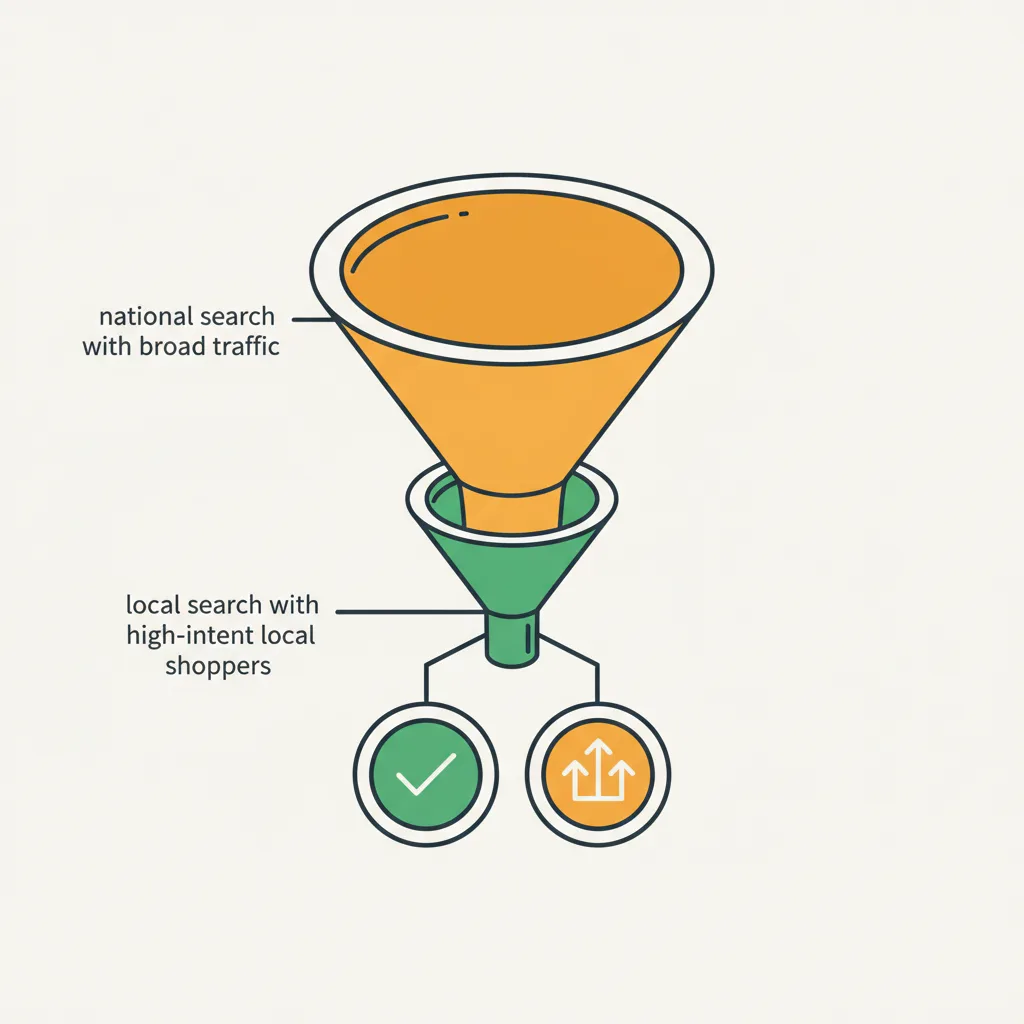
Answer Capsule: Hybrid approaches work for growing businesses, but prioritize local SEO first, then expand nationally once you have resources.
If your business grows and you want to expand beyond Georgia, you can layer national SEO on top of your local foundation. For example, a digital marketing agency might offer services to local Atlanta businesses while also creating national content that generates consulting leads from across the country. You’d need separate landing pages for national content, a broader content strategy, and investment in link building. HubSpot’s expansion strategy research shows that companies that master local markets first before expanding nationally have 60% higher success rates than those trying to compete nationally from the start.
How Much Budget Should You Allocate to Each Approach?
Answer Capsule: Budget allocation depends on your business model. Local businesses invest 100% in local SEO. Hybrid models split resources 70/30 initially.
Local SEO investments include Google Business Profile optimization, local citation building, review generation, and location-based content creation. These are typically lower-cost efforts with fast returns. National SEO requires stronger domain authority, comprehensive topic coverage, link building campaigns, and often content marketing. These investments take longer to pay off and cost more. If you’re spending $2,000 per month on SEO, a local-only business should allocate all $2,000 to local initiatives. A business planning national expansion might allocate $1,400 to local dominance and $600 to building the foundation for national competition.
What Are the Actual Business Results of Each Strategy?
Answer Capsule: Local SEO drives immediate customer action (phone calls, visits, purchases). National SEO builds long-term brand presence and authority.
A landscaping company in Atlanta optimizing locally might see 15-20 qualified phone calls per week within three months. A consulting business competing nationally might see 2-3 qualified leads per week after six months but with higher average deal value. These are different timelines and different customer acquisition patterns. BrightLocal’s 2024 local search consumer behavior study found that 57% of consumers won’t hire a service provider with fewer than four stars on Google reviews. This means local businesses need review management systems. National businesses need comprehensive content libraries. Both need quality SEO services but with different focuses.
Frequently Asked Questions
Can a small Atlanta business compete nationally on SEO?
It’s possible but requires significantly more resources and takes much longer. Most small businesses see better ROI investing in local dominance first, then expanding nationally after establishing financial stability.
Is Google Business Profile optimization only for local SEO?
Google Business Profile is primarily a local SEO tool, but it can appear in national search results for brand searches. However, if you’re competing nationally, your website and content strategy matter much more than your business profile optimization.
How long does it take to see results from local vs. national SEO?
Local SEO typically shows results within 3-6 months if you’re systematic. National SEO can take 6-12 months or longer because you’re competing against larger, more established websites.
Can I focus on both local and national SEO with a limited budget?
Yes, but you’ll spread your resources thin. It’s smarter to dominate locally first with 80% of your budget, then allocate 20% to testing national opportunities. Once local is generating consistent revenue, reinvest profits into national expansion.
How do I know if I should pursue national SEO?
Ask yourself: Can my business serve customers outside Atlanta? Do I have the resources to create 30+ pieces of comprehensive content? Can I afford 6-12 months without significant ROI? If you answered no to any of these, focus on local SEO first.
Atlanta’s most successful small businesses understand their market first. Local SEO isn’t a stepping stone to national competition—it’s a complete strategy for service-based businesses that thrive on geographic proximity and community trust. Whether you decide local SEO is enough or you’re building toward national growth, the foundation is the same: quality content, technical excellence, and genuine customer reviews. The question isn’t whether local or national SEO is better. The question is which one fits your business reality right now. Answer that honestly, and your SEO strategy will generate real results instead of wasted months chasing the wrong audience.