

Why We Replaced Retainers With Profit-Share (And What It Costs Us)
The real math behind Cause & Effect's 12% profit-share model. Why we killed the monthly retainer, what we absorb, and who it actually works for.

TL;DR
Cause & Effect replaced the traditional monthly retainer with a 12% profit-share model. Partners pay nothing upfront and nothing monthly. We absorb hosting, CRM, SEO tooling, and all labor. We only earn when the partner earns. The cost to us is real, and the alignment is the point.
What’s wrong with the retainer model anyway?
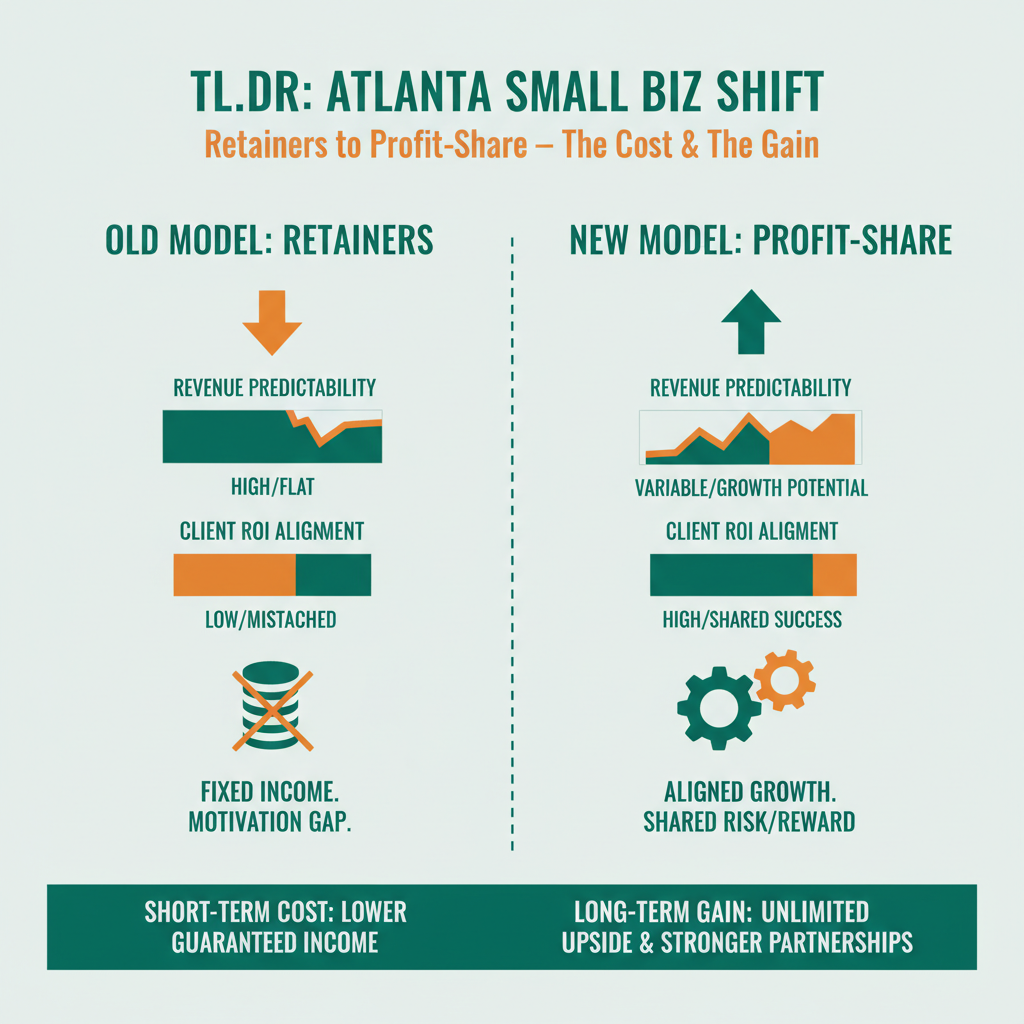
The retainer model charges a flat monthly fee whether the client grows, stalls, or shrinks. It rewards activity, not outcomes, which is why so many engagements quietly rot.
The typical agency retainer runs $2,000–$10,000 per month for a small service business, with 12-month contracts and “scope creep” clauses that punish founders for asking hard questions. According to SEMrush’s agency benchmarks, the median small-agency retainer is locked in before a single deliverable ships. That’s the business model: invoice first, results later.
Here’s what happens in practice. An agency signs a $4K retainer. Month one: strategy and onboarding. Month two: “foundational work.” Month three: a dashboard. By month six, the founder has paid $24,000 and still has no customers from the engagement. The agency has no structural reason to move faster, the money already cleared.
We watched this pattern play out across 40+ small business owners in Atlanta before we changed the model.
What is the profit-share growth partnership?
The profit-share growth partnership is a 12% revenue share with no retainer, no upfront cost, and no exit fee. We earn a percentage of monthly revenue, and nothing if there is none.
The structure is concrete. The partner pays for their own domain (roughly $12/year) and their own ad spend budget. That’s it. We absorb hosting on Cloudflare, the GoHighLevel CRM license, SEO tooling, DataForSEO keyword data, content production, development labor, and strategic hours [pctx_010]. A typical month of tooling and infrastructure we cover runs $380–$620 per partner, that’s our fixed cost before a single hour of labor gets counted.
The mechanics are simple. If a partner does $3,000 in revenue in a month, we earn $360. If they do $0, we earn $0. If they do $20,000, we earn $2,400. The percentage never changes. The contract never has scope creep. And the exit is month-to-month, if it’s not working, either side can walk.
Harvard Business Review’s research on incentive alignment shows that shared-outcome structures reduce principal-agent misalignment by 30–50% compared to fixed-fee arrangements. That’s the academic version of what we feel every day: when your paycheck depends on the partner’s paycheck, you stop optimizing for billable hours and start optimizing for results.
What does Cause & Effect actually absorb?
We absorb everything except the partner’s domain and ad spend. Hosting, CRM, tooling, labor, content, and strategy are all on us until revenue is flowing.
Here’s the breakdown of monthly cost we carry per partner before we earn a dollar:
| Line Item | Monthly Cost Absorbed | Notes |
|---|---|---|
| Cloudflare Pages hosting | $0–$20 | Usually free tier |
| GoHighLevel CRM (pooled) | $97–$147 | SaaS-level plan |
| DataForSEO API | $60–$120 | Keyword + backlink data |
| Domain tools + monitoring | $40–$60 | Uptime, audit, rank tracking |
| Labor (content, SEO, dev) | $1,800–$3,400 | 25–40 hours/month |
| Total absorbed | $2,000–$3,750 | Before partner pays $0 |
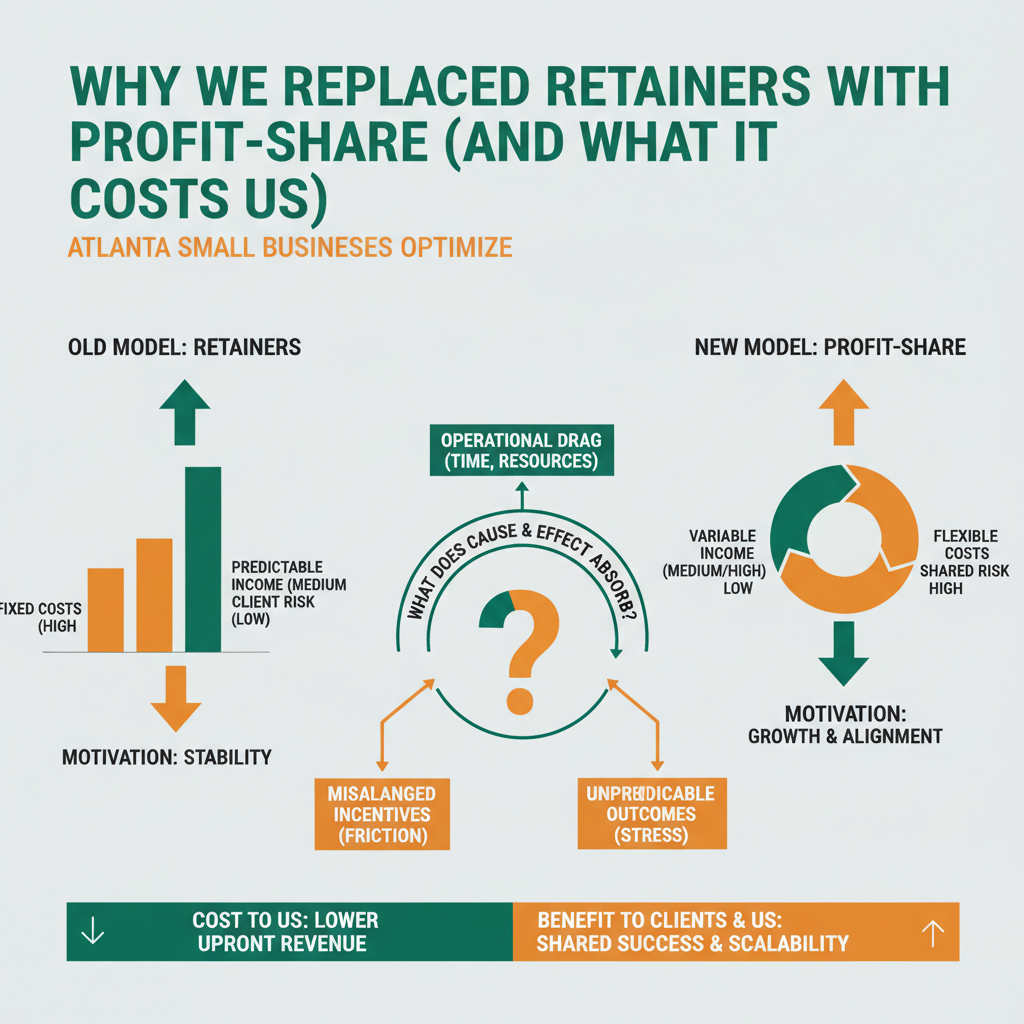
That’s real money. We carry it for a reason, the partners who qualify tend to scale fast, and the blended unit economics work across the portfolio.
How does the 100-day structure align with profit-share?
The 100-day structure compresses foundation-building into a fixed window so revenue starts flowing, and profit-share kicks in, inside three months instead of a year.
Phase 1 (days 1–30) is Clarity and Foundation: business setup, site live, first clients, one lead channel committed. Target: $100–$1,000 per month [pctx_011]. Phase 2 (days 31–60) is Consistency and Conversion: scale outreach, refine the sales process, build the financial model, run the first full CAC/LTV review. Target: $1,000–$4,000 per month. Phase 3 (days 61–100) is Scale and Stabilize: operations SOPs, scenario modeling, a six-month forward plan. Target: $5,000–$10,000+ per month.
The HubSpot 2024 State of Service Report found that service businesses with formalized 90-day growth plans grow revenue 2.3x faster than those operating month-to-month. The 100-day frame isn’t arbitrary, it’s the shortest window in which infrastructure, sales motion, and unit economics can all be validated at the same time.
One partner followed this structure and reached $30,000 per month in revenue with 100+ clients in 9 months [pctx_014]. At 12% that’s $3,600/mo to us, sustainable for both sides, and nothing close to what we’d have billed under a retainer.
How do the three disciplines combine under profit-share?
The partnership bundles three disciplines that agencies typically silo: digital infrastructure, financial modeling, and operations optimization. Profit-share is what makes that bundle economically honest.
Most agencies sell one of three things, marketing, finance consulting, or ops consulting, and charge separately for each. Under profit-share, the partner gets all three from one team, because carving them up would create internal conflict over billable hours [pctx_017]. The engineer builds the Astro site and SEO infrastructure. The finance co-founder builds the unit-economics model, tracks CAC and LTV, and runs break-even analysis. The operations side applies process efficiency, throughput analysis, and routing from a Georgia Tech ISYE discipline, the same toolkit used in supply chain and manufacturing, pointed at a 5-person service business.
According to a Clutch.co pricing survey, the average small business working with three separate vendors for web, marketing, and finance spends $6,800–$11,200 per month combined. Under our model they pay nothing until revenue moves, and when it moves, they pay one share, to one team, with one invoice.
What’s the catch?
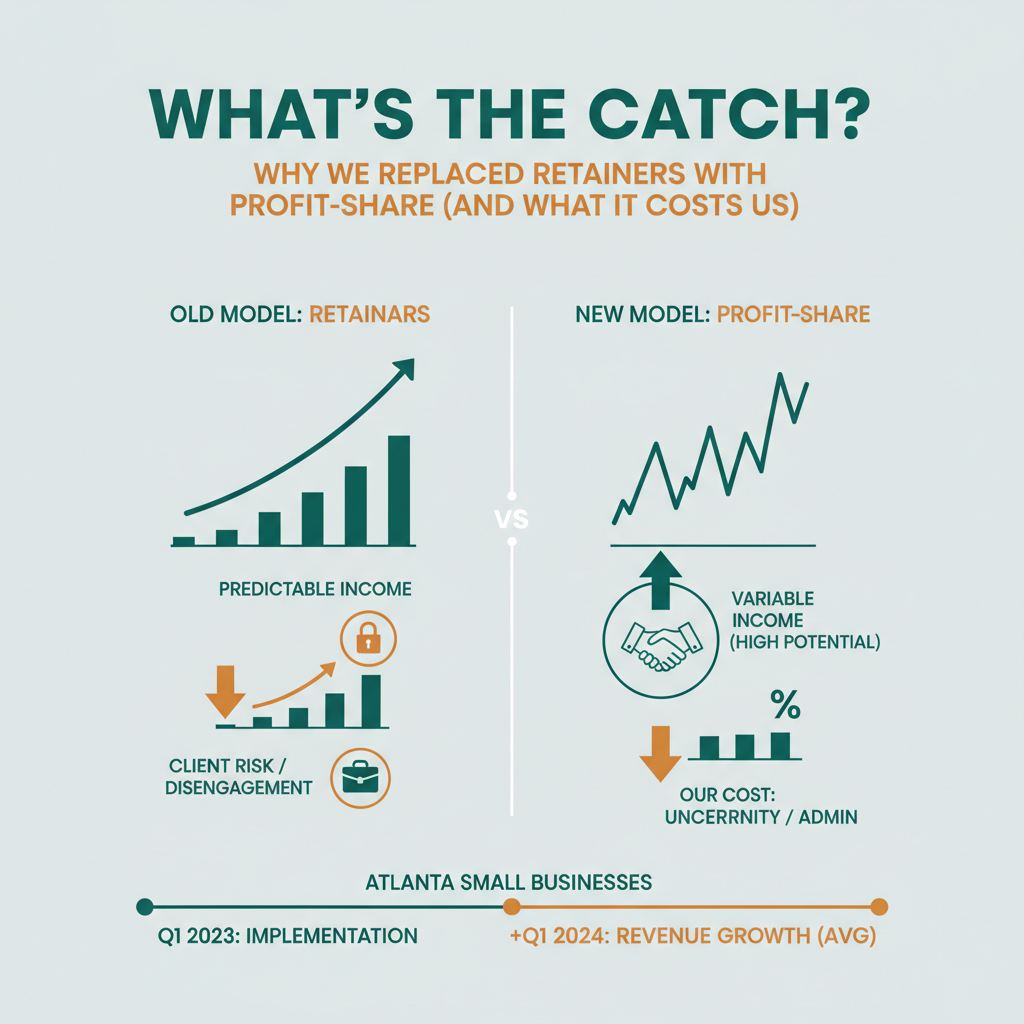
The catch is that profit-share only works with the right partners. We reject most inbound leads, and the rejection rate is the discipline that keeps the model solvent.
Qualification isn’t based on current revenue. It’s based on commitment: an existing business model or validated idea, willingness to commit 20+ hours per week, coachability, strong work ethic, and growth intent. If those five aren’t present, profit-share fails for both sides. The partner doesn’t execute. We absorb the cost. Nobody wins.
The commercialized services, web design, SEO strategy, CRM setup, paid ads, content marketing, exist specifically for founders who don’t qualify. They’re flat-fee engagements. Same quality, different structure. If you need the work but can’t commit the hours, we’ll still do it, just not under the partnership flag.
We wrote a qualification breakdown that walks through the five criteria in detail. Read it before booking a call. It saves everyone time.
What does the Atlanta context look like?
Atlanta service businesses are a natural fit. Dense metro, strong small-business density, high digital readiness, and a client base that responds to outcome-based pricing faster than to traditional agency sales.
We work across Atlanta, Decatur, Sandy Springs, Roswell, and Marietta. Those markets share a pattern: founders who’ve been burned by at least one retainer engagement and are allergic to the next. Profit-share lands with them because the incentive structure is the pitch. There’s nothing to sell them on, the math explains itself.
The commercialized fallback services also matter here. Atlanta’s legal, healthcare, and trade markets are full of businesses that don’t fit the partnership profile but still need SEO strategy or web design. The dual-track model means we don’t have to force every lead into the same box.
What does this cost us, really?
Honestly? It costs us margin. Every partner we onboard carries $2,000–$3,750 per month in absorbed cost before they generate a dollar. Multiply by the number of active partners in Phase 1, and the float is significant.
What we get back is alignment. Every hour we spend is an hour pointed at revenue, because revenue is how we get paid. There’s no internal tension between “what’s billable” and “what’s right.” The two are the same thing. That changes how work gets prioritized inside the firm. It changes which clients we take. It changes how fast we ship.
The model isn’t for every firm. Most agencies couldn’t carry the float or tolerate the rejection rate. That’s fine. Profit-share isn’t a universal answer, it’s a deliberate trade. We traded predictable monthly revenue for aligned outcomes. The partners who fit feel the difference immediately.
FAQ
What happens if a partner earns nothing in a month?
We earn nothing that month. The model has zero floor. We carry the absorbed cost, hosting, CRM, tooling, labor, and keep working. The profit-share is the guarantee: we only get paid when the partner gets paid [pctx_010].
Can I cancel the partnership?
Yes. The partnership is month-to-month. There’s no contract lock-in, no exit fee, and no minimum commitment. If it’s not working for either side, either side can walk. Most retainer contracts have 6–12 month lock-ins. Ours doesn’t.
How is this different from a commission-only agency?
Commission-only agencies typically charge a higher percentage (20–30%), on gross only, and focus on one channel (usually paid ads). Our 12% is net of ad spend, covers the entire digital stack, and includes financial modeling and operations work. It’s a partnership, not a commission arrangement.
Do I have to be in Atlanta?
Most partners are in the Atlanta metro because that’s where we live and where our local SEO and citation work compounds hardest. We’ve worked with partners outside Atlanta, but local is the default.
What if I don’t qualify for the partnership?
We offer commercialized services: web design, SEO strategy, CRM and automation setup, paid ads management, and content marketing, all flat-fee. Same quality, different structure. The services page has the details.
How fast do partners typically see revenue?
Phase 1 (days 1–30) targets $100–$1,000 per month. Phase 2 targets $1,000–$4,000 per month [pctx_011]. One partner hit $30K per month in 9 months. Speed depends on the founder’s hours, market, and sales cycle. We don’t promise timelines, we commit to the 100-day delivery guarantee.
What’s the 12% calculated on?
12% of monthly gross revenue, net of ad spend (which the partner pays directly, not through us). We don’t touch product costs, refunds, or partner payroll. It’s a clean top-line calculation.
Why 12% and not 10% or 20%?
We modeled it against our fixed cost of absorbed infrastructure and labor. 12% is the floor at which the portfolio math works, below that, we can’t carry the absorbed cost across multiple partners. Above that, partners start feeling squeezed at scale. It’s the honest number.
Get in Touch
If you’ve been burned by a retainer and want a model where the incentives actually align, book a qualification call. We’ll walk through the five criteria, explain the math, and tell you honestly whether the partnership or the commercialized services are the better fit. No pitch deck, no pressure, just math and a clear next step.
Christopher Drake Griffith is the co-founder of Cause & Effect Strategic Partners. Georgia Tech ISYE, supply chain focus. Based in Atlanta. LinkedIn.
Last updated: 2026-04-15