

How To Win Local SEO In Atlanta When You're A New Brand
A tactical playbook for new Atlanta brands competing for local search. Citation strategy, GBP optimization, content focus, and the 90-day rank timeline.

TL;DR
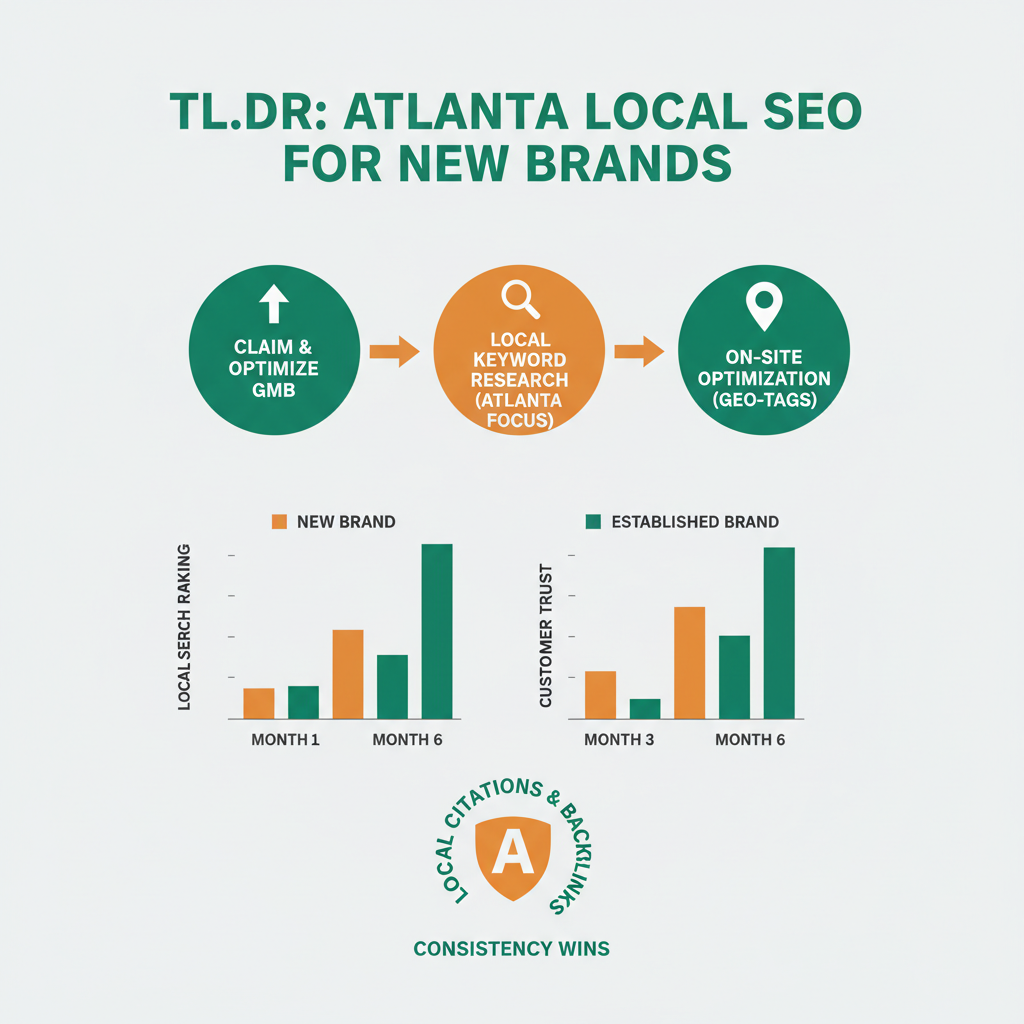
New brands can win local SEO in Atlanta with a disciplined first-90-days playbook: claim and optimize Google Business Profile, build 28+ citations across six categories starting with Tier 1 authority sources, publish hyper-local capsule content, and earn early reviews. No tricks. No black hat. Just the sequence that compounds.
Why is local SEO especially competitive in Atlanta?
Atlanta is one of the most competitive local search markets in the Southeast because of population density, business formation rate, and the concentration of legal, healthcare, and trade verticals fighting for the same keywords.
The metro Atlanta area has roughly 6 million residents and hosts hundreds of thousands of small businesses across 20+ submarkets, Atlanta proper, Decatur, Sandy Springs, Roswell, Marietta, Alpharetta, Dunwoody, Brookhaven, and beyond. Each submarket has its own search dynamics. A dentist in Buckhead faces different competition than a dentist in East Atlanta, even though both rank for “Atlanta dentist.”
BrightLocal’s local search ranking factors research shows that proximity to searcher, Google Business Profile completeness, and review quantity/quality are the top three ranking factors for local pack results. In Atlanta specifically, the proximity factor means that local rankings are often won at the submarket level, not the metro level. A new brand that dominates Decatur can out-rank established brands that dominate “Atlanta” generically when the searcher is in Decatur.
That’s the opportunity. New brands can skip the head-on competition for “Atlanta [service]” and win submarket-level visibility fast.
What are the first 30 days of local SEO for a new Atlanta brand?
The first 30 days focus on foundation: claim Google Business Profile, build the core NAP (name, address, phone) consistency across web properties, submit to Tier 1 citation sources, and publish initial local content.
Day 1–3: Claim Google Business Profile. Upload 10+ photos, select primary and secondary categories precisely, write a full 750-character business description with natural keyword inclusion, add service list with descriptions, and set service areas. Google’s Business Profile help documentation lists completeness as the single most important optimization factor. Incomplete profiles rank below complete ones even when other factors favor the incomplete one.
Day 4–10: Establish NAP consistency. The business name, address, and phone number must be identical across the website, Google Business Profile, and every citation source. “St.” vs “Street,” “Ste 200” vs “Suite 200,” and “(404) 555-1234” vs “404.555.1234” all count as mismatches. Pick one canonical format and use it everywhere.
Day 11–20: Submit to Tier 1 citation sources. For Atlanta service businesses, Tier 1 includes Google Business Profile, BBB Metro Atlanta, Yelp, Facebook Business, Apple Maps, Bing Places, and the Metro Atlanta Chamber of Commerce [pctx_006]. These are authority sources that carry significant weight in local search algorithms and also drive real referral traffic.
Day 21–30: Publish the first batch of local content, 3–5 blog posts or location pages targeting specific submarkets and service queries. Content quality matters more than volume at this stage.
How do you build citations without spamming?
Quality citation building means submitting to legitimate directories in a deliberate order, Tier 1 authority sources first, Tier 2 volume sources second, Tier 3 long-tail sources third. Spammy tools that blast to hundreds of low-quality directories produce backlinks Google discounts or penalizes.
Cause & Effect’s baseline citation strategy for Atlanta businesses targets 28+ submission sources across six categories [pctx_006]:
| Category | Example Sources | Priority |
|---|---|---|
| Directories | Yelp, Yellow Pages, Manta | Tier 1–2 |
| Chambers | Metro Atlanta Chamber, local chambers | Tier 1 |
| Industry listings | Clutch, Houzz, Avvo, Zillow (by vertical) | Tier 1 |
| Forums/Communities | Nextdoor, Reddit r/Atlanta, local Facebook groups | Tier 2 |
| Local media | AJC, Atlanta Business Chronicle, Atlanta Magazine | Tier 2–3 |
| HARO / PR platforms | HARO, Qwoted, Featured | Tier 3 |
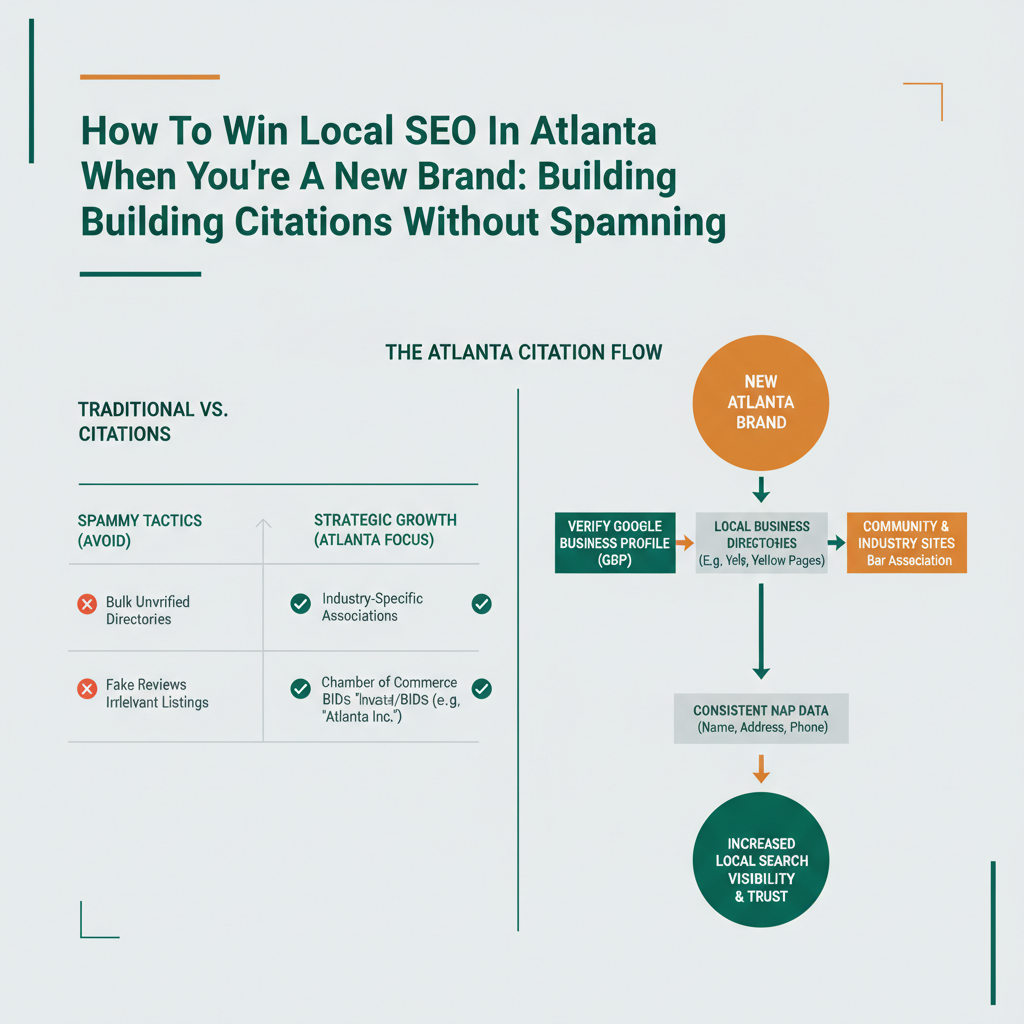
The discipline is one submission at a time, with NAP consistency checked on every one. Spraying citations is counterproductive because inconsistencies compound and have to be cleaned up later. A Moz local search guide found that citation cleanup is one of the most common high-impact interventions because poorly-managed early citations create drag on rankings for years.
What does Google Business Profile optimization actually look like?
GBP optimization goes beyond claiming and filling out fields. The high-leverage work is category selection, photo strategy, weekly posts, review management, and Q&A seeding.
Category selection is the highest-impact single decision. A primary category like “Family lawyer” ranks for different queries than “Personal injury attorney” even though both are legal. Get the primary category exactly right, then add up to 9 secondary categories that describe adjacent services. Don’t pad with irrelevant categories, Google explicitly flags that as a quality signal in the wrong direction.
Photo strategy matters more than most founders think. GBP photos should include exterior shots (for proximity confirmation), interior shots (for trust), team shots (for personality), and service/product shots (for intent matching). Upload 20+ photos in the first month and add 2–3 per week thereafter. Profiles with photo cadences rank measurably higher than static profiles.
Weekly GBP posts, offers, events, updates, signal active management. Search Engine Journal’s local SEO research shows that profiles with weekly posts outperform static profiles by 15–30% on pack inclusion rates. The post content doesn’t need to go viral; it just needs to show ongoing activity.
Review management is the long game. Ask every customer for a review after a successful engagement. Respond to every review, positive and negative, within 24–48 hours. Review count and recency are both ranking factors, and response rate signals active management to Google’s local algorithm.
Q&A seeding: pre-populate the GBP Q&A section with common customer questions and provide authoritative answers. This prevents the void from being filled by random users and gives you another surface for keywords and capsule-structured content.
How does content compound locally?
Local content compounds when it’s submarket-specific and capsule-structured. A post titled “Best Family Lawyer in Decatur” with question-form H2s and direct-answer capsules outranks generic Atlanta-level content for Decatur searchers, even from a new brand.
The submarket-specificity is the lever. Atlanta-level keywords (“Atlanta family lawyer”) face maximum competition. Submarket-level keywords (“Decatur family lawyer,” “Sandy Springs family lawyer”) face a fraction of the competition because fewer brands are explicitly targeting the submarket. A new brand that publishes one high-quality post per submarket in its first 90 days can realistically rank in the top 10 for several of them.
The capsule structure is what makes the content citable by AI search engines and extractable for featured snippets. We covered this in depth in The Capsule Content Method post, but the short version is: question-form H2s, 40–60 word answer capsules, cited statistics every 150–200 words, 5+ FAQ questions, and FAQPage schema.
The compounding effect: each submarket post brings in a trickle of local traffic and builds topical authority. After 20–40 posts, the domain has enough local relevance for Google to start ranking it for broader Atlanta queries too. That’s how new brands climb the local ladder, submarket first, metro-level second.
What are the top 3 mistakes new Atlanta brands make?
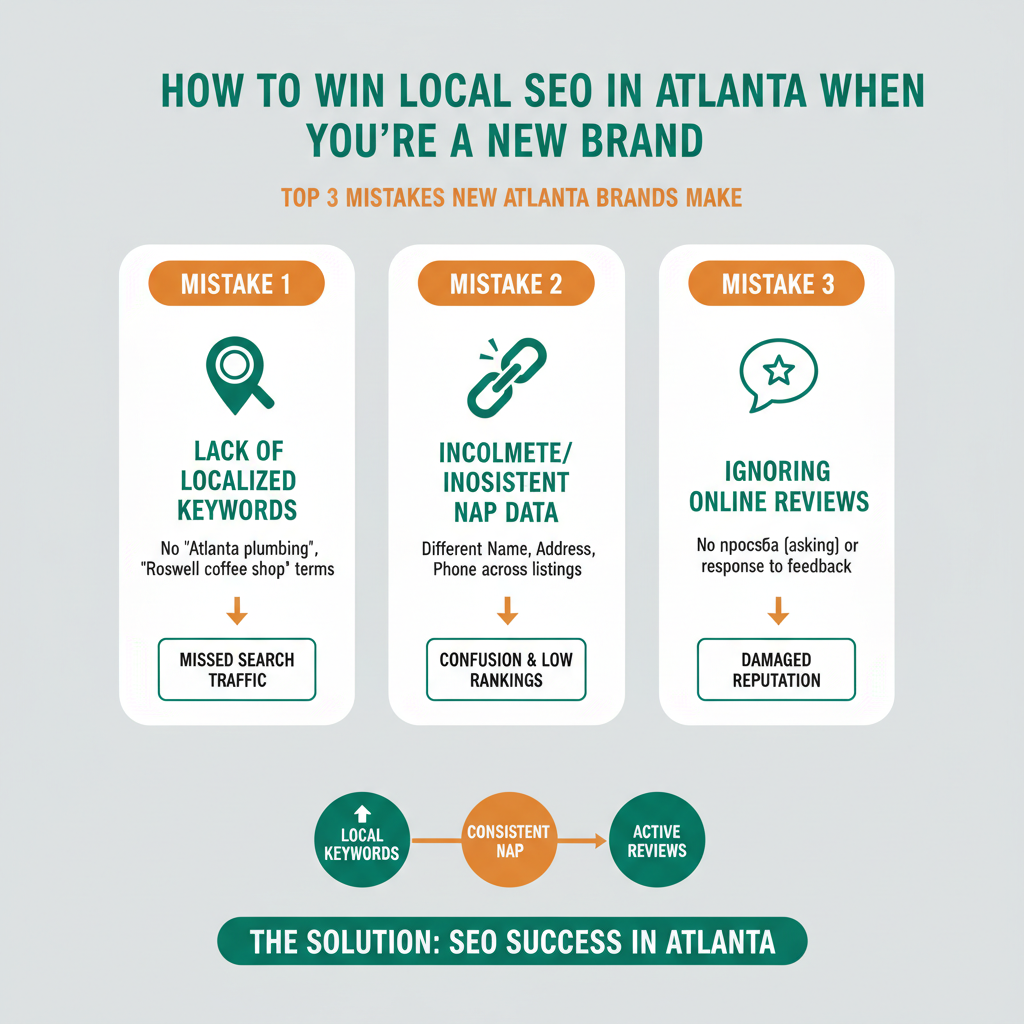
The three most common mistakes are (1) chasing metro-level keywords before submarket authority is built, (2) inconsistent NAP across citations, and (3) treating reviews as optional instead of foundational.
Chasing metro-level keywords first is a waste of effort for new brands. The head terms are locked up by established competitors with years of backlink equity and review volume. A new brand that targets “Atlanta family lawyer” as its first content priority spends months producing content that will never crack the top 20. Starting with submarket-level keywords lets early wins compound into broader authority.
NAP inconsistency is mechanical but under-prioritized. Every citation with a different address format creates drag. Every phone number variation confuses the local algorithm. The fix is boring, document the canonical format on day one and never deviate, but founders skip the documentation step and then spend hours cleaning up later.
Reviews are foundational, not optional. A business with 50 reviews at a 4.6 average ranks differently than a business with 5 reviews at a 5.0 average, even when other factors are identical. BrightLocal’s research found that 93% of consumers read online reviews before making a local purchase decision. Zero reviews creates zero trust signals. The first 10 reviews are disproportionately valuable.
What does a 90-day ranking timeline look like for a new Atlanta brand?
A disciplined new brand should expect submarket-level ranking progress in weeks 4–8 and metro-level progress starting in weeks 10–14. Faster than that is possible but uncommon. Slower than that usually indicates a foundation problem.
Weeks 1–4: foundation only. GBP claimed and optimized, NAP consistent, initial citations submitted, first content published. Rankings are minimal or nonexistent. This is expected, Google hasn’t had time to crawl and index the new signals.
Weeks 5–8: early submarket rankings. Long-tail submarket queries (“Decatur dentist reviews,” “Sandy Springs CPA near me”) start appearing in positions 15–30. This is the first concrete signal that the foundation is working.
Weeks 9–12: submarket pack inclusion. Some submarket queries move into the local pack (positions 1–3). Review count starts mattering. Content velocity starts compounding. The first real lead volume from organic search usually appears in this window.
Weeks 13+: metro-level progress. Broader Atlanta queries start ranking on page 2–3. Submarket queries move higher in the pack. Referral traffic from Tier 1 citations begins. This is the transition from “building” to “scaling.”
Cause & Effect tracks this timeline against baseline metrics for every partner. Our baseline audit at onboarding documents starting position, keyword count, GBP status, citation count, review count [pctx_009], so progress is measurable against a clear starting point, not a vague narrative.
FAQ
How long does it take to rank in Atlanta local pack?
Submarket-level pack inclusion typically takes 6–12 weeks for a disciplined new brand with strong GBP optimization, consistent citations, and early reviews. Metro-level Atlanta pack inclusion usually takes 4–8 months. Competitive verticals (legal, healthcare) run on the longer end.
Do I need a physical address in Atlanta to rank locally?
Yes, for local pack rankings. Google requires a valid physical address within the service area for GBP eligibility. Virtual offices and PO boxes don’t qualify. Service-area businesses can hide the address publicly but still need a real one on file.
How many citations should I submit in the first 30 days?
Target 15–20 in the first 30 days, starting with Tier 1 authority sources. Spraying more citations faster doesn’t help. Quality and NAP consistency beat volume.
What’s more important, reviews or citations?
Both matter and neither substitutes for the other. Reviews are a stronger ranking factor once you’re past the first 20. Citations are more important in the first 90 days when the business is establishing existence signals. Do both in parallel, not sequentially.
Should I use a citation-building service?
For Tier 1 citations, do them manually, they require thoughtful business descriptions and category selection that generic services botch. For Tier 2 and Tier 3 volume citations, a quality service (like Whitespark or BrightLocal) is efficient. Avoid anything that promises hundreds of citations cheaply.
How do I handle duplicate Google Business Profiles?
Claim both profiles, merge the one with fewer reviews/photos into the one with more, and request removal of the duplicate through Google’s support process. Duplicates split ranking signals and confuse the algorithm.
Can I rank locally without a blog?
Yes, but slowly. Blog content accelerates local rankings by building topical authority and providing capture pages for long-tail queries. Without content, you’re relying entirely on GBP and citations, which caps your ceiling.
Does Cause & Effect handle Atlanta local SEO?
Yes. Every 100-Day Growth Partnership includes full local SEO, GBP optimization, 28+ citation submissions, capsule content, review management, and ongoing tracking. Partners outside the partnership can engage commercialized local SEO as a standalone service.
Get in Touch
If you’re a new Atlanta brand trying to win local search, the first 90 days decide the next 12 months. Book a qualification call and we’ll review your current foundation, identify the biggest gaps, and tell you honestly whether the partnership or standalone local SEO is the right fit.
Christopher Drake Griffith is the co-founder of Cause & Effect Strategic Partners. Based in Atlanta. LinkedIn.
Last updated: 2026-04-15